Outsourcing statistics for 2026 show an industry projected to reach $695.77 billion by 2033, with companies shifting their focus from cost alone to access, agility, and AI-augmented talent. Here are 60+ outsourcing statistics for 2026 sourced from Deloitte, IBPAP, Grand View Research, Mordor Intelligence, and Clutch, organized by category so you can find the data you need fast.
What Are the Most Important Outsourcing Statistics for 2026?
The most important outsourcing statistics for 2026 point to a market that has fundamentally changed. Cost is no longer the primary driver. Only 34% of executives now cite cost reduction as their main reason for outsourcing, down from 70% in 2020 (Deloitte Global Outsourcing Survey 2024). What replaced it? Access to specialized talent, digital transformation capabilities, and AI-augmented service delivery.
This roundup covers 60+ outsourcing statistics across eight categories: global market size, why companies outsource, cost savings, IT outsourcing, call center outsourcing, small business outsourcing, Philippines outsourcing, and AI in outsourcing. If you want to understand what business process outsourcing is before reading the data, that guide covers the fundamentals.
Sources include Deloitte’s 2024 Global Outsourcing Survey, IBPAP’s 2025 industry report, Grand View Research (2026), Mordor Intelligence (2026), Clutch (2024), and SupportNinja/CMSWire (2024). All stats are traceable to a named primary source.
Global Outsourcing Market Size & Growth Statistics
The global outsourcing industry is large, resilient, and accelerating. Here are the market size and growth figures that matter most heading into 2026.
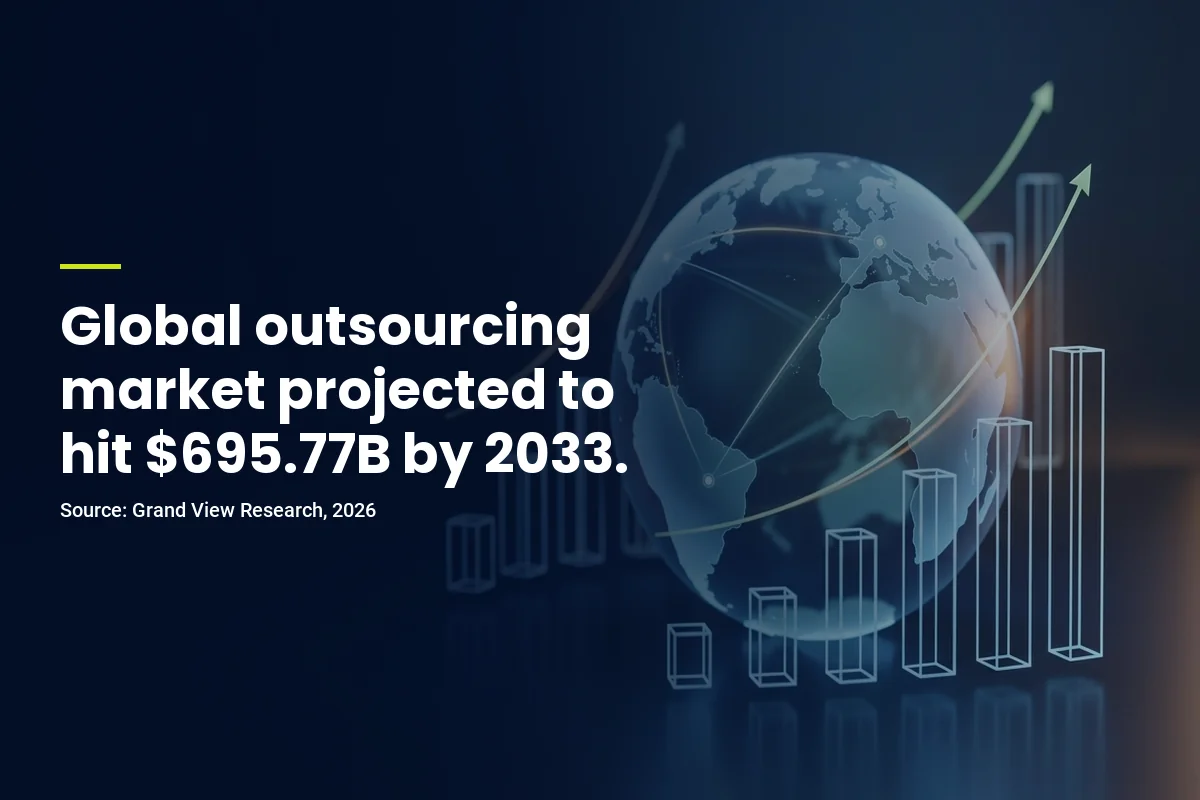
The global BPO market is projected to reach $695.77 billion by 2033, growing at a 9.9% CAGR.
According to Grand View Research (2026), the global business process outsourcing market is on a sustained growth trajectory, driven by digital transformation investments and increased enterprise adoption. The 9.9% compound annual growth rate reflects demand across IT services, finance, HR, and customer operations.
Per industry analyst estimates aggregating ISG and Grand View Research data, when traditional BPO is combined with IT outsourcing and shared services agreements, total market value exceeded $1 trillion in 2025. This figure reflects the full scope of third-party service relationships that global enterprises manage, including technology infrastructure, back-office operations, and knowledge process outsourcing.
According to Grand View Research (2025), North America remains the largest regional contributor to global BPO market share. US-based companies are the world’s largest consumers of outsourced business services, particularly in IT, finance, and customer support functions.
The US IT outsourcing market is valued at $185.33 billion in 2026 and projected to reach $235.63 billion by 2031.
According to Mordor Intelligence (2026), the US IT outsourcing segment is growing at a 4.92% CAGR through 2031. This makes the United States both the largest market for outsourced IT and the top source of global outsourcing contracts.
According to Deloitte’s Global Outsourcing Survey, IT services consistently rank as the largest single category of outsourcing spend. Finance, accounting, and payroll rank second and third. For readers looking for specific payroll outsourcing data, that category has grown significantly in the past two years.
Approximately 300,000 jobs are outsourced from the United States each year.
This widely cited figure reflects the ongoing trend of US companies delegating functions, particularly IT, customer service, accounting, and data processing, to external providers. Developing countries in Southeast Asia and Latin America capture the largest share of this work.
| Region | BPO Market Share (2025) | Key Segments |
|---|---|---|
| North America | 37.4% | IT services, finance BPO, digital transformation |
| Asia-Pacific | ~28% | Philippines and India delivery hubs |
| Europe | ~22% | Nearshore Eastern Europe, GDPR-compliant delivery |
| Rest of World | ~12.6% | Latin America nearshore, MENA expansion |
Why Companies Outsource in 2026: Drivers & Decision Statistics
The reasons companies outsource have shifted dramatically since 2020. The data below, drawn primarily from Deloitte’s 2024 Global Outsourcing Survey, tells the real story.
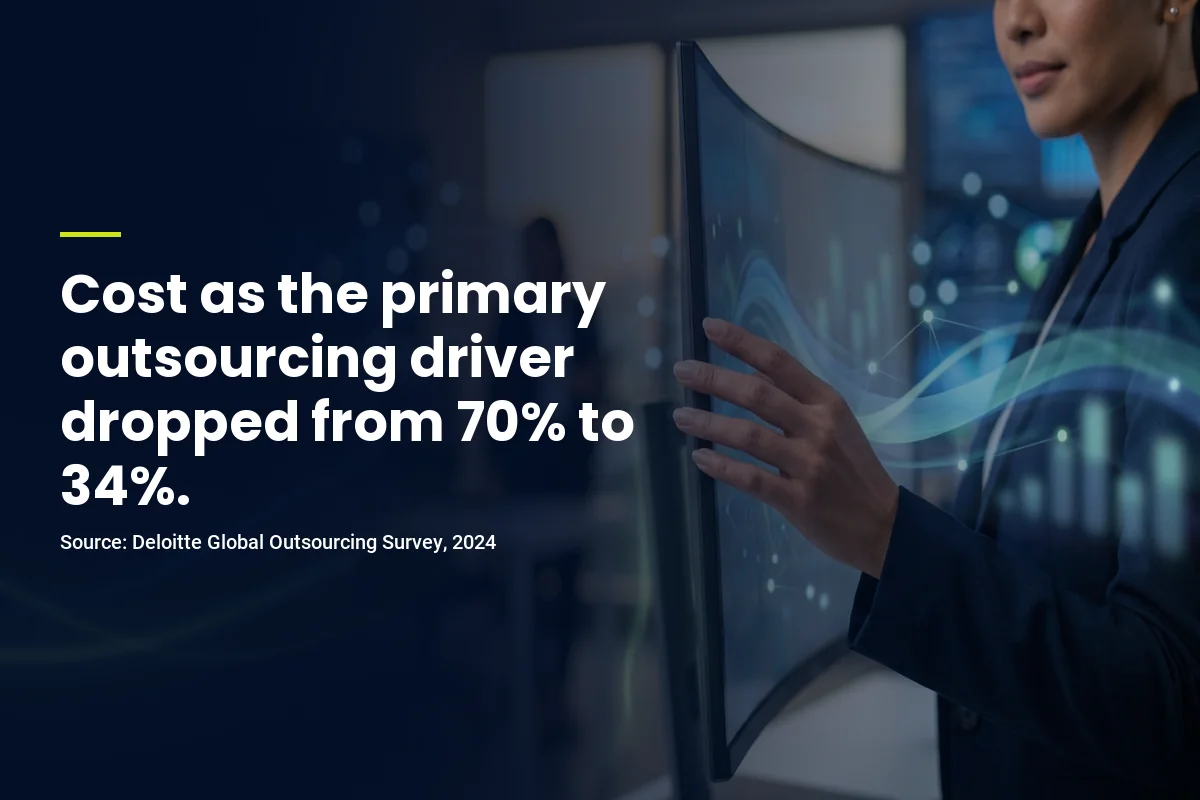
Only 34% of executives cite cost as their primary outsourcing driver in 2024, down from 70% in 2020.
According to the Deloitte Global Outsourcing Survey 2024, cost reduction has fallen dramatically as the number-one driver. In its place: access to digital capabilities, specialized talent, and operational flexibility. This shift signals that outsourcing has matured from a cost-cutting tactic into a genuine strategic function for enterprises of all sizes.
80% of executives plan to maintain or increase their outsourcing investment over the next 12 months.
According to Deloitte (2024), eight in ten executives said they expected to keep or grow their third-party service relationships. Demand for outsourced services is not slowing. This signals that outsourcing is increasingly embedded in core business strategy rather than treated as discretionary spend.
63% of companies increased their outsourcing budgets in 2024.
According to SupportNinja and CMSWire (2024), nearly two-thirds of companies actively expanded their outsourcing spend last year. The increase was concentrated in customer experience, IT support, and back-office operations. For more data on customer service statistics for 2026, that post tracks CX trends alongside outsourcing adoption rates.
78% of large organizations use Global In-house Centers alongside traditional outsourcing.
According to Deloitte (2024), the majority of large enterprises now run a hybrid model, combining captive offshore centers with third-party outsourcing contracts. GICs give companies more direct control over offshore teams while still capturing the cost advantages of offshore delivery.
87% of organizations count contractors and outsourced teams in their active workforce headcount.
According to Deloitte (2024), the boundary between employee and outsourced worker has effectively blurred for most large organizations. The vast majority now formally count external contractors and outsourced teams as part of their workforce planning, not as peripheral vendors.
50% of companies used outsourced services for front-office functions like sales, marketing, and R&D in 2024.
According to Deloitte (2024), outsourcing has moved well beyond back-office functions. Half of surveyed organizations outsourced at least one front-office capability. The outsourcing pros and cons post covers how companies are navigating this expanded scope responsibly.
Cost Savings & Outsourcing ROI Statistics
Even as cost-cutting falls as a primary driver, the cost advantage of outsourcing remains real and significant. Here are the figures on what companies actually save.
Outsourcing can reduce labor costs by up to 70%.
According to the Deloitte Global Outsourcing Survey, companies that shift to outsourced delivery in cost-competitive markets, particularly the Philippines and India, can realize labor cost reductions of up to 70%. This figure accounts for salary differentials, employer benefits, facility overhead, and recruitment costs. Customer service outsourcing is one of the most common functions where this savings level is achieved.
Companies save an average of 22% by outsourcing HR operations.
According to data compiled by SHRM, HR outsourcing delivers consistent savings across recruitment, payroll processing, benefits administration, and compliance management. The 22% average saving reflects the combined cost of eliminating in-house HR headcount, software subscriptions, and training expenses. See the HR outsourcing trends post for current adoption patterns.
Outsourcing HR operations leads to a 10-12% reduction in HR staff size.
When companies outsource payroll, recruiting, and benefits management, they typically reduce their in-house HR headcount by 10 to 12 percent. This right-sizing allows internal HR leaders to focus on culture, strategic talent planning, and employee experience rather than transactional administration.
Outsourcing recruitment results in a 97% client satisfaction rate.
Companies that delegate recruitment to specialized outsourcing partners report near-universal satisfaction with the process and outcomes. The high satisfaction rate reflects time savings, faster time-to-hire, and access to screened candidate pipelines that in-house teams often cannot replicate at scale.
Large companies are 128% more likely to outsource at least one function than small businesses.
Larger organizations run more departments, serve larger customer bases, and operate at a scale where the cost savings and specialization benefits of outsourcing are most pronounced. This scale advantage explains why enterprise contracts dominate total market value even as small business adoption grows.
IT & Software Development Outsourcing Statistics

IT remains the single largest category in global outsourcing. Here are the numbers that define the sector in 2026.
The US IT outsourcing market is $185.33 billion in 2026 and projected to reach $235.63 billion by 2031 at a 4.92% CAGR.
According to Mordor Intelligence (2026), the United States IT outsourcing segment is expanding steadily. Growth is concentrated in cloud infrastructure management, cybersecurity services, application development, and AI-enabled IT support functions.
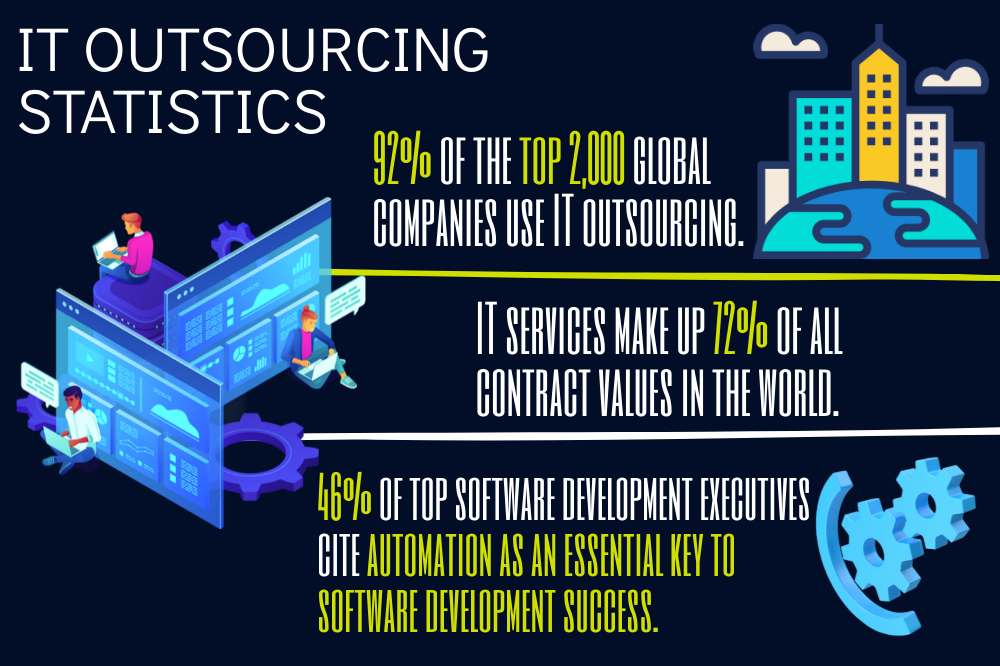
92% of the world’s 2,000 largest companies use IT outsourcing.
According to ISG (Information Services Group), IT outsourcing is nearly universal among the world’s largest enterprises. Only 8% of G2000 companies handle all IT functions entirely in-house, and most of those operate in highly regulated sectors with strict data residency requirements.
83% of IT leaders outsource at least one function specifically to strengthen data security.
Per Deloitte (2024), cybersecurity, managed IT services, and compliance monitoring are among the most commonly outsourced IT functions. The specialization required to stay current with emerging threats means most organizations cannot maintain best-in-class security posture using only internal resources.
74% of firms worldwide rely on BPO providers for at least one IT function.
Nearly three-quarters of global firms delegate at least one technology function to an external provider, whether helpdesk support, software development, infrastructure management, or data processing. IT outsourcing has become standard operating practice across industries.
93% of organizations are exploring or actively using cloud-based solutions through outsourcing partnerships.
Cloud adoption and IT outsourcing are increasingly intertwined. Providers that offer cloud migration, cloud-native application development, and managed cloud services capture the majority of new IT outsourcing contracts. This trend accelerated through 2024 and is projected to sustain through 2028.
46% of software development executives say automation is essential to project success.
In a survey by Tempo, software development leaders identified automation and AI-assisted development tooling as critical to on-time delivery. This explains why top outsourcing destinations increasingly compete on AI tooling maturity alongside labor cost and language proficiency.
The global app outsourcing market is projected to reach $129.90 billion by 2028 at a 1.84% CAGR.
Mobile application development remains a steady outsourcing category. US companies account for the largest share of global app development outsourcing spend, with approximately $44 billion in projected US revenue in the segment. This reflects the ongoing demand for specialized mobile development talent outside North American salary ranges.
Call Center & Customer Service Outsourcing Statistics
The statistics below focus on outsourced call center operations specifically: market adoption, cost structure, and the Philippines’ market position. For general contact center performance metrics, AHT, FCR, CSAT, and agent productivity, see our separate post on 40+ call center statistics.
The Philippines holds an estimated 10-15% of the global outsourced customer experience market.
According to industry estimates from IBPAP (2025), the Philippines is the world’s leading destination for outsourced customer service and voice BPO, capturing a larger share of the global outsourced CX market than any other country, including India, which leads in IT. Filipino contact center agents handle inbound and outbound calls, chat support, email management, and back-office CX processing for companies across the US, UK, and Australia.
An outsourced call center agent in the Philippines costs $924 to $1,764 per month, compared to $4,000 to $5,000 per month for an in-house US agent.
The cost differential between outsourced and in-house customer service delivery is the economic foundation of call center outsourcing. The US agent cost includes salary, benefits, employer taxes, facilities, and management overhead. The Philippines figure is an all-in monthly seat cost. That gap represents 60-70% in potential savings, consistent with Deloitte’s overall outsourcing cost reduction data.
59% of businesses outsource customer service to reduce operational costs.
According to SupportNinja (2024), cost efficiency remains a central driver for customer service outsourcing specifically, even as it has declined as a driver for outsourcing overall. Contact center operations carry high fixed costs: agent salaries, telephony infrastructure, real estate, and training overhead. Outsourcing converts these fixed costs into a variable, per-seat model.
50% of organizations now outsource at least one front-office function including customer service, sales, or marketing support.
Per the Deloitte Global Outsourcing Survey 2024, front-office outsourcing now accounts for half of all outsourcing engagements. The shift from back-office-only outsourcing to front-office outsourcing reflects growing confidence in the quality and reliability of outsourced CX teams. Learn more about customer service outsourcing options for your business.
The global call center outsourcing market is projected to grow at a 5.1% CAGR through 2030, driven by North American and Australian demand.
Per Grand View Research, US, UK, and Australian companies account for the largest share of global call center outsourcing contracts. Demand growth is driven by rising in-house labor costs, difficulty recruiting contact center staff in Western markets, and the improving quality benchmarks set by top Philippine and Indian BPO providers.
Small Business Outsourcing Statistics
Outsourcing is no longer the exclusive domain of large enterprises. Small businesses are adopting it at increasing rates, particularly for functions that do not require physical presence.
37% of small businesses outsource at least one business function.
According to Clutch, more than one-third of small businesses worldwide delegate at least one operational function to an external provider. IT, accounting, and marketing are the most commonly outsourced categories for small businesses globally.
83% of US small businesses plan to maintain or increase their outsourcing spend.
According to Clutch (2024), the vast majority of small US businesses that currently outsource intend to sustain or grow that investment. Price, industry experience, and team diversity are the three most commonly cited selection criteria when small businesses choose an outsourcing partner.
The top outsourced functions for US small businesses are IT services, accounting, and digital marketing.
According to Clutch (2024), these three categories dominate small business outsourcing because they require specialized expertise that most small companies cannot maintain in-house affordably. IT and accounting in particular carry significant financial and compliance risk when errors occur, making professional outsourcing a straightforward value proposition.
32% of American companies outsource at least one HR task.
According to SHRM, HR outsourcing has expanded well beyond large enterprises. Nearly a third of all US companies, including small and mid-size businesses, now delegate at least one HR function. Payroll, benefits administration, and recruiting are the most commonly outsourced HR tasks at the SMB level.
Accounting is the second most outsourced business service globally, with 37% of organizations outsourcing their accounting processes.
According to Clutch, only IT outsourcing is more widely adopted than accounting outsourcing. Finance and accounting BPO covers tax preparation, bookkeeping, payroll, and financial reporting. Tax preparation is outsourced by 71% of companies that use accounting BPO, making it the most commonly outsourced accounting task. The outsourced accounting function is also one of the fastest-growing segments in the Philippines BPO market.
Philippines Outsourcing Industry Statistics
No country section in this roundup carries more current data than the Philippines. IBPAP’s 2025 and 2026 reports provide fresh benchmarks that most global stats compilations have not yet incorporated. For a full Philippines BPO industry overview, that post covers the sector’s history, structure, and trajectory in detail.
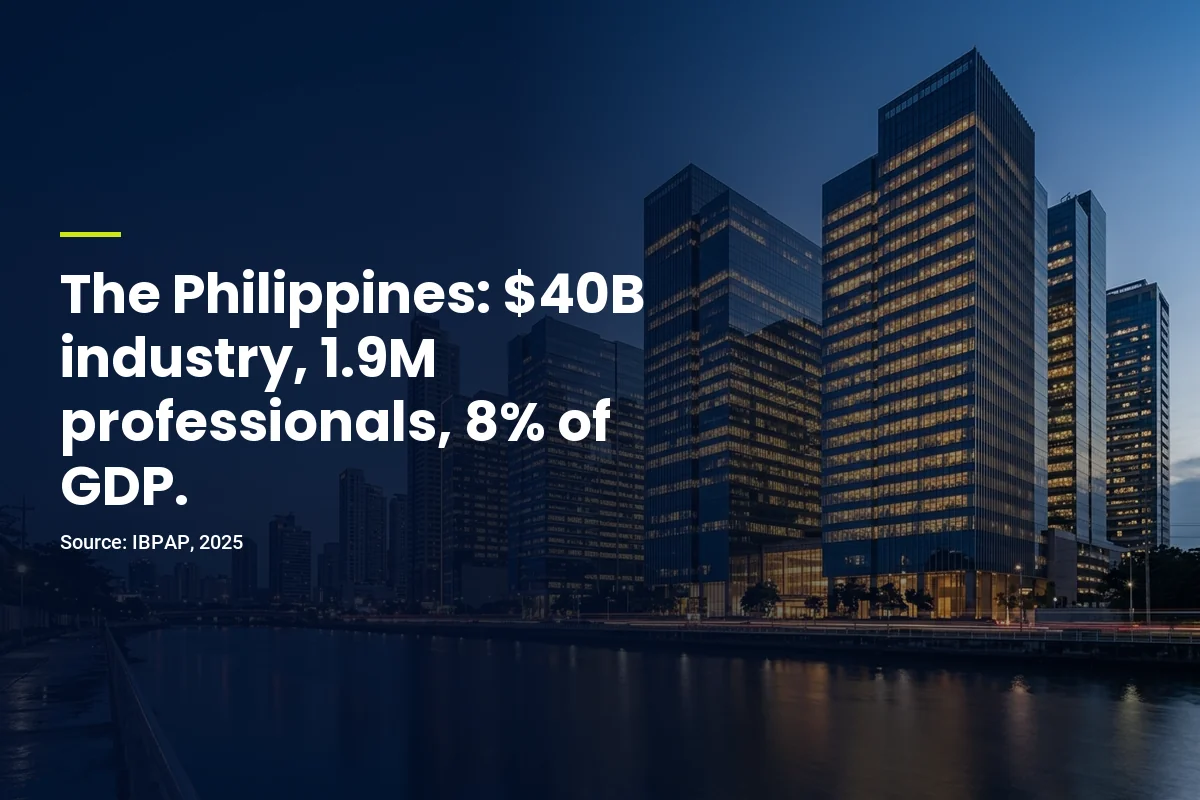
The Philippine IT-BPM sector ended 2025 with $40 billion in export revenues and 1.9 million workers.
According to IBPAP (Information Technology and Business Process Association of the Philippines, 2025), the sector closed 2025 ahead of earlier projections, reaching $40 billion in export revenues and employing 1.9 million workers across voice, non-voice, IT, and knowledge process outsourcing. This makes the Philippines IT-BPM sector one of the largest single-country BPO industries in the world.
The Philippines IT-BPM industry is projected to generate $42 billion in revenues and employ 1.97 million workers by the end of 2026.
According to IBPAP’s 2026 roadmap projections, the sector continues on a steady growth path. The $42 billion revenue target and 1.97 million employment projection reflect demand growth in higher-value services including legal process outsourcing, financial analytics, and software development, alongside continued strength in customer experience delivery.
The Philippines IT-BPM sector is projected to reach $59 billion in revenues and 2.5 million workers by 2028.
According to IBPAP’s long-range roadmap, the Philippine BPO industry is expected to grow into a $59 billion sector within two years. This trajectory assumes continued growth in AI-augmented services and the Philippines’ continued success attracting higher-value contracts from the US, UK, and Australia. See the list of top Philippine BPO providers for an overview of who is driving this growth.
The Philippine IT-BPM sector contributes more than 8% of the country’s GDP.
According to IBPAP (2025), IT-BPM export revenues represent over 8% of the Philippines’ gross domestic product, making it one of the most economically significant industries in the country alongside remittances and tourism. This scale of contribution also reflects the government support the sector receives in infrastructure, education pipelines, and regulatory frameworks.
The Philippines IT-BPM sector grew at 5% in 2025, outpacing the global average of 3%.
According to IBPAP (2025), the Philippines grew at nearly twice the global BPO sector average last year. The above-average growth reflects the country’s competitive advantage in English-language CX delivery, its growing share of higher-value knowledge process outsourcing, and the accelerating adoption of AI tools among Filipino BPO teams.
The Philippines holds an estimated 10-15% of the global BPO market.
The Philippines is the world’s top destination for outsourced customer experience and voice BPO. Its market share in outsourced CX work exceeds that of any other country. Digital Minds BPO, a business process outsourcing company with over 15 years of operations in Naga City, Philippines, is one of the providers within this sector, serving clients across the US, UK, and Australia with a 94% client retention rate.
1.5 million Filipinos work through digital platforms in remote or project-based arrangements outside formal BPO employment.
According to Payoneer (2023), beyond the 1.9 million workers in formal BPO employment, roughly 1.5 million Filipinos participate in the outsourcing economy through freelance platforms and remote work arrangements. This broader talent pool expands the range of skills available to companies exploring Philippines-based outsourcing partnerships.
AI in Outsourcing: Augmentation Statistics
AI is not replacing outsourced workforces. The data tells a different story: AI is being deployed to elevate outsourced teams, handling repetitive tasks so human agents can focus on judgment-intensive work that requires empathy, context, and expertise.
67% of Philippine IT-BPM companies have adopted AI tools to move workers into higher-value, judgment-intensive roles.
According to IBPAP (2025), two-thirds of Philippine BPO companies have integrated AI tools into their delivery model. IBPAP frames this explicitly as augmentation: AI handles routine, scripted interactions so that human agents can focus on tasks requiring cultural fluency, empathy, and complex problem-solving. This is not displacement. It is elevation.
83% of executives say AI capabilities are now part of their outsourced service delivery.
According to Deloitte (2024), the majority of outsourcing relationships now include some element of AI-enabled service delivery. This includes AI-assisted quality monitoring, intelligent routing, automated back-office processing, and agent-assist tools that surface relevant information during live customer interactions.
73% of companies consider AI capabilities moderately or very important when selecting an outsourcing partner.
According to SupportNinja and CMSWire (2024), AI readiness has become a mainstream selection criterion. Nearly three-quarters of decision-makers now evaluate a provider’s AI tooling, automation capabilities, and AI governance practices as part of the vendor selection process.
65% of SaaS and technology companies use multiple outsourcing partners, compared to 28% in other industries.
According to SupportNinja (2024), technology-native companies are significantly more likely to run multi-vendor outsourcing strategies. This reflects their comfort with distributed service models and their tendency to select specialized providers for distinct functions rather than consolidating with a single generalist BPO.
AI adoption in BPO is expanding the scope of outsourceable work, not shrinking it.
The net effect of AI in outsourcing has been to broaden the range of tasks that remote teams can deliver efficiently. By automating tier-1 queries and routine data processing, AI tools free outsourced agents to handle complex interactions that were previously considered too difficult to outsource. This has made outsourcing viable for higher-value functions in legal, financial, and medical services.
Frequently Asked Questions About Outsourcing Statistics
What percentage of companies outsource?
According to Deloitte’s 2024 Global Outsourcing Survey, 87% of organizations actively count contractors and outsourced teams as part of their workforce, and 80% plan to maintain or increase outsourcing investment in the next 12 months. At the small business level, Clutch reports that 37% of small businesses outsource at least one function. Outsourcing is now standard practice across all company sizes.
What is the current size of the global outsourcing market?
The global BPO market is projected to reach $695.77 billion by 2033, growing at a 9.9% CAGR, according to Grand View Research (2026). When IT outsourcing and shared services are included, the combined market was worth approximately $1.09 trillion in 2025. North America holds 37.4% of the global BPO market share.
How many jobs are outsourced from the US each year?
Approximately 300,000 jobs are outsourced from the United States each year. This figure covers formal outsourcing contracts in functions including IT support, customer service, accounting, data processing, and software development. Developing countries in Southeast Asia and Latin America capture the largest share of this work.
Why do companies choose to outsource in 2026?
The primary drivers have shifted significantly. According to Deloitte’s 2024 survey, only 34% of executives now cite cost reduction as their main reason, down from 70% in 2020. The top drivers in 2026 are access to specialized skills, digital transformation capabilities, operational agility, and AI-enabled service delivery. For a full analysis, the post on reasons companies outsource covers the data in detail.
How much money can outsourcing save a business?
Outsourcing can reduce labor costs by up to 70% compared to equivalent in-house teams in Western markets, per Deloitte. HR outsourcing saves an average of 22% in operational costs. For customer service specifically, an outsourced agent in the Philippines costs $924 to $1,764 per month, compared to $4,000 to $5,000 per month for an in-house US agent. Actual savings depend on function type, volume, and delivery market.
What percentage of small businesses outsource?
According to Clutch, 37% of small businesses outsource at least one business function. Among US small businesses that already outsource, 83% plan to maintain or increase that spend in 2024, per Clutch (2024). The most commonly outsourced functions for small businesses are IT services, accounting, and digital marketing.
Which country is the top outsourcing destination in 2026?
The Philippines is the top destination for outsourced customer experience and voice BPO, holding an estimated 10-15% of the global outsourced CX market. India leads in IT outsourcing. The Philippines IT-BPM sector ended 2025 with $40 billion in export revenues and 1.9 million workers, growing at 5% versus a 3% global average, per IBPAP (2025). The post on top outsourcing destinations provides a full country-by-country comparison.
Is AI replacing outsourced workers?
No. According to IBPAP (2025), 67% of Philippine BPO companies have adopted AI specifically to elevate workers into higher-value, judgment-intensive roles, not to reduce headcount. Deloitte (2024) found that 83% of executives say AI is now part of their outsourced service delivery as a complement to human teams. AI handles routine, scripted tasks; human agents handle complex, relationship-driven interactions. The net effect has been an expansion of what is outsourceable, not a reduction in outsourced employment.
Conclusion
The outsourcing industry in 2026 is larger, more strategically positioned, and more AI-capable than at any point in its history. The headline number, a $695.77 billion BPO market projected by 2033 (Grand View Research), reflects genuine enterprise demand growth. The more telling statistic is the motivational shift: from 70% of executives citing cost as their primary driver in 2020, to just 34% in 2024 (Deloitte). Cost savings remain real, but access to talent and digital capabilities now drive the decision.
The Philippines stands out in this data set. Growing at 5% versus a 3% global average (IBPAP 2025), the sector closed 2025 with $40 billion in export revenues and 1.9 million workers, with a clear roadmap to $59 billion and 2.5 million workers by 2028. The 67% AI augmentation adoption rate (IBPAP 2025) signals that Filipino BPO teams are not waiting to be disrupted by AI. They are deploying it to deepen the value they deliver.
Digital Minds BPO, a business process outsourcing company with over 15 years of operations in Naga City, Philippines, serves clients across the US, UK, and Australia with a 94% client retention rate and an average partnership length of 4.7 years. If these statistics give you a starting point, the next step is a conversation. We can help you map which functions are most ready to outsource and what realistic savings look like for your situation. Explore the top Philippine BPO providers or read our guide to the Philippines BPO industry overview to go deeper.

Charvel Rebagay is the CEO and Founder of Digital Minds BPO, a Philippines-based outsourcing company he established in 2010. Based in Naga City, he works directly with clients and teams daily to ensure service quality across every engagement. With over 15 years of experience building and managing dedicated teams for businesses worldwide, Charvel has helped hundreds of companies scale their operations through skilled Filipino professionals. Under his leadership, Digital Minds BPO operates 3 dedicated facilities with a 94% client retention rate, serving Fortune 500 clients including P&G and Petron.