Skip to content
Services · Truck Dispatch

Truck Dispatch Services for Established Fleets

Your dispatch desk shouldn’t be a single point of failure. When a single person covers 30 trucks across two shifts, a sick day or an overnight breakdown can unravel an entire day’s operations. Our dedicated dispatchers join your team, cover your shifts, and keep your drivers moving. You keep control. We take the pressure off.

  • Dedicated truck dispatchers for shift coverage, exception escalation, TMS updates, and after-hours coverage.
  • Works inside your existing dispatch stack (Samsara, Motive, KeepTruckin, McLeod, TruckingOffice, and more).
  • Save up to 70% compared to equivalent in-house dispatch staffing.
See what we do (and what we don’t)
15+Years operating
94%Client retention
24/7Shift coverage
Scope Clarity

What We Do, What We Don’t

Scope clarity is rare in this industry. Most truck dispatch outsourcing services are built for owner-operators looking for load board access and rate negotiation. That’s not what we do. If you’re reading this expecting a service that finds freight for you, we’re not your fit, and we’d rather tell you that now than waste your time.

Truck dispatch outsourcing, as we define it, means an external team handles the daily coordination of your fleet: driver check-ins, exception management, route monitoring, delivery updates to your customers, and the paperwork that keeps your billing current. The outsourced team works as a dedicated extension of your operations, covering the shifts your in-house team can’t or doesn’t want to staff. This is fleet coordination support for carriers that already have their own loads and shipper relationships.

What we do

  • Driver coordination and check-ins throughout the shift, including pre-trip and post-trip confirmations
  • Exception handling: breakdowns, weather delays, refused deliveries, missed appointments, and driver emergencies
  • Route monitoring and real-time adjustments when conditions change
  • ETA updates to your merchants, receivers, and customers
  • BOL and POD processing and document management throughout the day
  • 24/7 shift coverage, including overnight, weekend, and holiday staffing
  • Billing and invoicing support to keep your back-office current

We provide truck dispatch support for established carriers. Our dispatchers work as a dedicated extension of your operations team.

What we don’t

  • Source loads on your behalf or work load boards
  • Negotiate broker rates or run freight brokerage
  • Owner-operator full-stack dispatch
  • Load matching or rate negotiation
  • Build your shipper or customer book
  • Replace your in-house operations leadership

Doing one thing well beats doing five things poorly. We built our bench for fleet coordination, and that’s where we perform.

Who We Serve

Who We Serve

Not every carrier needs what we offer. Before investing 30 minutes in a discovery call, check whether your operation fits the profile we work best with.

Primary buyer

Established regional and national carriers (10-150+ trucks)

Carriers with their own shipper relationships who need consistent, reliable dispatch coverage across shifts. Operations managers and fleet supervisors who have loads coming in but lack coverage for overnight and weekend shifts without adding expensive domestic headcount.

Logistics middleware

3PLs and 4PLs with their own driver networks

Logistics providers who need dispatch coordination as a back-office function separate from their freight management software.

Dedicated-lane operators

Regional carriers operating in dedicated lanes

Operators who need overnight or weekend coverage without adding headcount at domestic payroll rates. Trucking dispatch services here typically mean 2-4 dedicated dispatchers across a three-shift model.

Last-mile / middle-mile

Box truck operators in metropolitan corridors

15-50 box trucks running tight appointment windows at retailer loading docks, with high check-in frequency and significant exception volume during peak periods.

Capability Map

Our Truck Dispatch Services

We organize our dispatch capabilities by what the dispatcher actually does operationally, not by what kind of truck you drive. Here’s what a dedicated DMI truck dispatch service covers.

01 · Coordination

Driver Coordination and Check-Ins

Shift start and end check-ins, pre-trip verification, mid-route wellness calls, and post-delivery confirmations. For truck driver dispatch, consistent check-in cadence is the foundation of everything else. When a driver goes quiet, your dispatcher is the first to know and the first to act.

This includes maintaining your driver roster, tracking available hours under FMCSA Hours of Service rules, and flagging drivers approaching HOS limits before it becomes a compliance event.

02 · Exceptions

Exception Handling: Breakdowns, Delays, and Refused Deliveries

Exceptions are where most internal dispatch operations break down overnight. When a driver hits a closed dock at 11 PM, your dispatcher reaches the backup receiving contact, reschedules the appointment, and sends the merchant an updated delivery window before the morning shift starts.

Exception handling covers breakdowns and roadside coordination, weather-related lane closures, receiver refusals, missed appointment windows, and driver emergencies. The dispatcher coordinates the response, notifies the relevant parties, logs the event in your TMS with timestamps, and escalates to your operations manager through your chosen channel.

03 · Routing

Route Monitoring and Adjustments

Your dispatchers monitor active loads throughout the shift. When a highway closure or severe weather event affects a lane, the dispatcher identifies affected trucks, pulls up the routing options in your TMS, and notifies drivers before they hit the problem.

This is not reactive. It’s the kind of forward-looking watch that prevents a 30-minute delay from becoming a missed delivery.

04 · Communication

ETA Updates to Merchants and Customers

Shippers and receivers want accurate delivery windows. Your dispatchers send ETA updates at agreed intervals, or triggered by exceptions, directly to your customers, merchants, or receiving teams using your existing communication channels.

If a reefer load running into a grocery DC is running 40 minutes late due to traffic, the receiver hears about it from your dispatcher before they start calling your operations manager.

05 · Documentation

BOL and POD Processing

Document handling is high-volume, detail-sensitive work that ties up experienced staff. Your dedicated dispatchers handle BOL verification, POD collection from drivers, and document submission to the relevant systems or portals.

A driver delivers, photographs the signed POD, and sends it to the dispatcher through your chosen channel. The dispatcher logs it, submits it where it needs to go, and flags any discrepancies. Your billing team gets clean documentation, not a pile of unprocessed delivery records.

06 · Coverage

24/7 Truck Dispatch Coverage

The core operational benefit for most carriers considering outsourced trucking dispatch services. A 24/7 truck dispatch model with three eight-hour shifts needs staffing reliability across all three. DMI’s office-based dispatchers in Naga City, Philippines provide time-zone coverage that aligns with US and Canadian operating hours, including the overnight windows that are hardest to staff domestically.

No call-ins. No staffing gaps. Your shift coverage is there.

07 · Back office

Billing and Invoicing Support

Detention time, lumper charges, fuel surcharges, and accessorial fees all need to be captured and invoiced accurately. Your dispatchers support your billing cycle by logging charges as they occur, flagging disputes, and ensuring that revenue you earned is revenue you collect.

/ · Next step

Ready to map this against your fleet?

A 30-minute discovery call covers shift structure, TMS platform, and exception playbook so both parties know whether the engagement makes sense.

A 24-Hour Shift

How Dispatch Actually Works

Every competitor page we’ve seen shows you an onboarding checklist. None of them explain what happens after day one, when your dispatcher is sitting at the desk at 2:47 PM and a driver calls with a transmission failure outside Pittsburgh.

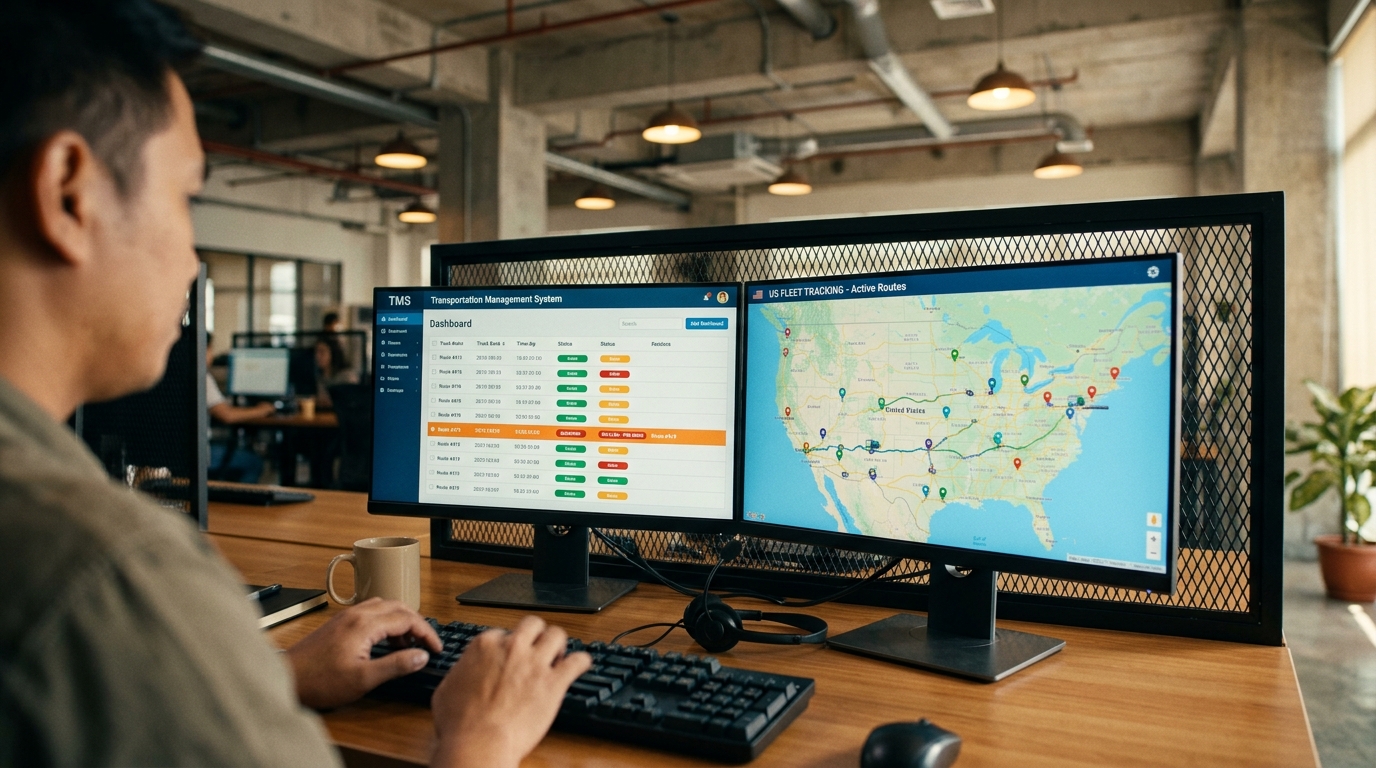
Dispatcher workstation with dual-monitor transportation management system at the Digital Minds BPO Naga City office
6:00 AM ET

Shift Handoff

The outgoing overnight dispatcher completes the shift report: active loads, any exceptions that occurred, drivers still en route, and any open items requiring follow-up. The incoming morning dispatcher reviews the report and picks up active communication threads before the overnight team logs off. No load or driver falls through the shift transition.

7:00 – 10:00 AM

Morning Driver Check-Ins

Dispatchers run through the departure board. Each driver gets a pre-trip confirmation: location, load details, appointment window, and any routing notes for the day. HOS hours are checked against scheduled run times. Drivers with tight margins get flagged for monitoring. The dispatcher updates your TMS with confirmed departure times.

10:00 AM – 2:00 PM

Active Route Monitoring

The dispatcher watches the board. For a fleet of 30 trucks, that means 30 active position traces running in your TMS. When truck number 14 drops off check-in cadence, the dispatcher calls. There’s a backup at a receiver’s dock. The dispatcher logs the detention start time, notifies the shipper, and updates the ETA for the next stop.

2:47 PM
Exception 1 · Breakdown

Box Truck Driver, I-76 outside Pittsburgh

Driver Mike calls in. Box truck. Transmission failure. On I-76 westbound, twenty miles outside Pittsburgh. Here’s what happens in the next 15 minutes for this truck driver dispatch event:

  1. Dispatcher confirms Mike’s precise location and load details.
  2. Dispatcher checks whether the load has a temperature or time sensitivity.
  3. Dispatcher contacts your preferred roadside assistance provider. If no preferred vendor exists, dispatcher uses the backup list in your exception playbook.
  4. Dispatcher notifies the receiver that the delivery window is affected and provides an updated ETA based on estimated repair or transfer time.
  5. Dispatcher logs the exception in your TMS with timestamps.
  6. Dispatcher sends a summary to your operations manager via your chosen channel (email, Slack, whatever your team uses).
Mike gets help. The receiver has accurate information. Your TMS has the event documented. Your ops manager sees it in their inbox, not as a 6 AM surprise.
4:15 PM
Exception 2 · Temperature Alarm

Reefer Load, Walmart DC Dock

A driver running a reefer load is staged at the receiving dock at a Walmart distribution center. The trailer’s temperature alarm fires. The receiver is holding the driver, waiting on instructions before they accept the load.

  1. Dispatcher confirms the alarm reading and the load manifest (temperature-sensitive product type, acceptable range).
  2. Dispatcher checks whether the alarm is within acceptable variance or whether there’s a genuine temperature excursion on record.
  3. Dispatcher contacts your preferred reefer maintenance contact or carrier’s equipment manager to assess whether it’s a sensor fault or a real event.
  4. Dispatcher communicates status to the receiver dock supervisor to prevent the load from being refused on a false alarm.
  5. Dispatcher logs the event in your TMS and documents the chain of custody for the load.
  6. If the excursion is real, dispatcher escalates to your operations manager with load documentation so a claim decision can be made.
The driver gets instructions. The receiver gets answers. The documentation is clean. This is a scenario that goes sideways fast if no one is watching.
5:00 – 8:00 PM

End-of-Day Wrap

Dispatchers confirm delivery of daytime loads, collect POD acknowledgments, and log any outstanding detention or accessorial charges. BOL documents are processed and filed. The shift report is prepared for the evening team.

8:00 PM – 6:00 AM

Overnight Monitoring

The shift most carriers struggle to staff. The overnight dispatcher watches the board for drivers still running, handles any exceptions that arise, and manages early-morning departures. Cross-border loads are clearing customs. Weather systems in the west start affecting eastern delivery windows. Your overnight dispatcher is there. Not on call. Not a forwarded phone number. Present and watching.

This is what fleet-level dispatch support looks like operationally. If you’re evaluating whether your operation needs this kind of coverage, the discovery call is a good place to map your shift model against ours.

Staffing Math

Dispatcher-to-Truck Ratio: The Math Behind Fleet Coverage

The industry benchmark for fleet coordination dispatch is one dispatcher per 10 to 15 active trucks per shift. This is not a DMI standard. It’s the operational reality for truck driver dispatch work: one person managing more than 15 trucks across a single shift is stretched thin, and exception handling quality starts to drop.

1:1015
Dispatcher to active trucks per shift

The benchmark, not a marketing number

This ratio holds across the industry because exception load scales with truck count. Beyond 15 trucks per dispatcher per shift, quality of monitoring and response time degrade in observable ways. We build engagements around this constraint, not around it.

Example A
10 trucks Single shift

Shifts1
Dispatchers1
DMI / mo$1,428
Example B
30 trucks 24/7 operation

Shifts3
Dispatchers6 – 9
DMI / mo$8.5k – $12.9k
Example C
50 trucks 24/7 operation

Shifts3
Dispatchers10 – 15
DMI / mo$14.3k – $21.4k

Pricing rows show Mid Level dispatcher rates. Below 3 dispatchers the managed-service model doesn’t function; minimum engagement is 3 dispatchers.

Pricing

Transparent Monthly Pricing

Most truck dispatch services charge a percentage of load revenue, typically 3-10% per load. That model makes sense for one specific situation: when your dispatcher is finding the loads. Percentage pricing is built around revenue the dispatcher generates by sourcing freight for you. Your dispatchers aren’t finding loads. They’re running the fleet you already have.

Mid Level

1–3 years dispatch experience
$1,428/mo
$8.50/hr · 168 hrs/mo
  • Dedicated office-based dispatcher
  • Team Lead included (1 per 15 dispatchers)
  • Project Manager included
  • First 5 days TMS training, free
  • No setup, recruitment, or management fees

Most truck dispatch engagements use Mid Level dispatchers. Expert Level is appropriate for fleet operations with complex exception playbooks, multi-TMS environments, or roles that require significant independent judgment.

What’s included (no hidden costs)

  • Your dedicated dispatcher, office-based in Naga City, Philippines
  • A Team Lead at no charge (1 Team Lead per 15 dispatchers)
  • A Project Manager at no charge
  • First 5 days of training on your TMS and exception playbook, free
  • No setup fees, no recruitment fees, no management fees

You see the proposal rate. You pay the proposal rate.

How this compares to US-based dispatch labor

A mid-level in-house dispatcher in the US typically costs $40,000–$55,000 annually in base salary, plus benefits, recruiting, and overhead. That’s $3,300–$4,600 per month per person, before you factor in overtime for overnight shifts.

At $1,428/month, the savings are real. Most carriers running truck dispatch outsourcing at this rate save 65-70% compared to domestic staffing for the same function.

A note on the percentage model

Resolute Logistics, TruckDispatch360, and similar services charge 3-10% of gross load revenue. For a carrier running $500,000/month in freight, that’s $15,000-$50,000 per month in dispatch fees. With 10 dispatchers at Mid Level DMI pricing, your all-in cost is $14,280/month.

The math is straightforward. Fixed pricing at fleet scale is almost always the better model when you already have the loads.

TMS Capability

TMS Platform Capability: We Train on Your System

Here’s the honest version of TMS compatibility: we don’t claim to have dispatchers already expert in every platform. What we do instead is train every dispatcher on your specific TMS before they go live. They arrive ready to use your system the way your current team uses it.

McLeod TMS 01

One of the most widely used TMS platforms in North American fleet operations.

Samsara 02

ELD-integrated. Strong on real-time GPS and HOS tracking.

Motive 03

Formerly KeepTruckin. Popular with mid-size and regional carriers for ELD compliance and driver app integration.

Trimble TMS 04

Common in larger private fleets and dedicated contract carriers.

Truckin Digital 05

Growing adoption among asset-based carriers.

Custom or proprietary 06

Any platform, including in-house TMS builds. We adapt to your system rather than ask you to adapt to ours.

Before your dispatcher starts

We use the first 5 days of training (included at no cost) to onboard on your TMS. If your platform has a sandbox or training environment, we train there. If not, we build a documented workflow from your existing SOPs and your operations team’s guidance.

Platform complexity

Standard commercial TMS platforms (McLeod, Samsara, Motive) typically require 3-5 days to reach operational proficiency for experienced dispatchers. Custom or proprietary platforms with non-standard workflows may require an extended ramp, which we discuss during the discovery call before any engagement starts.

No TMS surprise costs. No “our platform doesn’t support yours” disclaimers mid-engagement.

Differentiation

Why Outsource Truck Dispatch to Digital Minds BPO

Several dispatch services compete in this space. Here’s what makes a 15-year-old BPO with 94% client retention different from a pure-play dispatch startup.

01 · Track record

Running 24/7 operations since 2010

Shift coverage, exception escalation, and production-floor supervision are not new problems for us. We’ve been building teams that operate that way across multiple industries: towing dispatch, limousine dispatch, taxi dispatch, courier dispatch.

02 · Retention

94% retention over 15 years

Clients don’t keep renewing for 4.7 years on average because the service is mediocre. Retention at that rate, sustained over 15 years, is the clearest proof point we have. We don’t manufacture it. We report it.

03 · Hiring

You interview every dispatcher

We recruit to your criteria. You conduct the final video interviews. You approve the team. Your dispatcher doesn’t start until you’ve decided they’re right for your operation. This is the opposite of receiving a generic hire and hoping they fit.

04 · Dedicated

Your dispatcher works exclusively for you

Not a shared pool, not a call queue. A dedicated dispatch professional assigned to your fleet, learning your drivers, your routes, your exception playbook, and your TMS. The longer they’re on your account, the more valuable they become.

05 · Facility

Office-based. Always.

Our dispatchers work from our Naga City facilities, not from home. 24/7 CCTV. Biometric floor access. No personal phones on the production floor. 100% activity recording. Your fleet data is handled in a supervised, secure environment.

06 · Privacy

NDAs before data access

Every dispatcher signs an NDA before they see any of your operational data. This is a standard condition of engagement, not an optional upgrade.

07 · Scale

3 facilities, capacity to scale

If your fleet grows, your dispatch team grows with it. We’ve built and scaled client-specific teams of 50 agents and beyond. Scaling dispatch from 3 to 10 dispatchers is operationally straightforward for us.

08 · Compounding value

Teams that learn your operation

The carriers that stay with DMI long-term aren’t just buying hours. They’re running an outsourced dispatch function that becomes more effective over time as the team learns the operation.

Digital Minds BPO production floor in Naga City with dispatchers working at industrial workstations
Facility

This is where your dispatchers actually sit.

Three Naga City facilities. Biometric floor access. 24/7 CCTV. Hardened workstations. 100% activity recording. No spare-bedroom laptops. The supervised environment is part of what you’re paying for, and it’s the part that’s hardest to verify until you see it.

Trust & Compliance

Data Security and Compliance

Dispatch operations involve driver personal data, shipper and receiver business information, load manifests, and route data. The carrier and the BPO both have obligations here. Here’s how DMI handles those obligations.

Physical facility security

Biometric production-floor access. 24/7 CCTV across operational areas. Personal phones, USB drives, and personal storage devices prohibited. Hardened workstations with disabled USB ports.

100% activity recording

All dispatcher activity is recorded and archived. You get a complete audit trail of every interaction, every TMS update, and every communication made on your behalf.

NDA-bound dispatchers

Every dispatcher signs a Non-Disclosure Agreement before accessing your operational data. Non-negotiable on all engagements.

Data processing clauses

Your service agreement includes data processing language covering how your operational data is handled, stored, and protected during the engagement.

Philippines DPA & GDPR-aware

Compliance with Republic Act 10173 (Philippines DPA). Certified Data Protection Officer on staff. GDPR-aware procedures for EU-adjacent data subjects.

PIPEDA for Canadian carriers

PIPEDA permits cross-border transfer when contractually equivalent protections are in place. We address this through our NDAs and data processing clauses, which bind DMI to the same standard the carrier would apply under PIPEDA itself. Transactional dispatch communications are exempt from CASL commercial consent requirements under CRTC guidelines.

HIPAA-adjacent capability

For healthcare-adjacent logistics clients, we provide a Business Associate Agreement and HIPAA training certificates through our EPICompliance program.

What we don’t claim

We have not achieved SOC 2, GLBA, FCRA, PCI-DSS, or ISO 27001 certification. We won’t tell you we have, because we don’t. If a specific certification is a hard requirement for your engagement, we’ll tell you that up front rather than misrepresent our posture.

What we do have: 15 years of operating a supervised, documented, NDA-bound, fully-recorded BPO environment for clients in logistics, finance, healthcare, and government. That operational track record is what most carriers actually care about.

Operational Track Record

Operational Track Record

We don’t have named logistics dispatch client testimonials to offer yet. This page is part of a new dedicated vertical for established carriers, and we’d rather be honest about that than fabricate social proof. What we do have is 15 years of operating dispatch-adjacent services at production scale.

Continuous Operations
15+ yrs

Running 24/7 shift-based operations since 2010 through staffing changes, technology shifts, and multiple facility expansions in Naga City.

Client Retention
94%

Average client tenure of 4.7 years. Retention at this rate reflects the relationship working, not the contract auto-renewing.

Facilities
3 sites

Naga City, Philippines. Proven ability to build single-client teams of 50+ agents. Dispatch from 3 to 15 agents is well within range.

Dispatch-Adjacent Bench
4 verticals

Towing dispatch, limousine call center, taxi dispatch, courier coordination. Overlapping capabilities with truck fleet dispatch.

Fortune 500 and government validation

P&G and Petron trust DMI for business-critical operations. The Bureau of Customs Philippines ran their official call center through us for three years. We’re not a small startup that hasn’t been tested under real operating conditions.

P&GPetronBureau of Customs PH
Digital Minds BPO Team Lead reviewing shift performance dashboard with two dispatchers
Onboarding

Getting Started: How Onboarding Works

Most carriers that contact us are already past the “should we outsource?” question. They want to know what the actual experience of getting a dispatcher up and running looks like. Here’s the four-step path from initial call to dispatchers working your shifts.

30 minutes

Discovery Call

We map your fleet: active trucks, shift structure, operating region, TMS platform, and the specific gaps you’re trying to fill. We also talk through your exception playbook, or help you develop one.

At the end of the call, both parties know whether this engagement makes sense.

15-30 days

Custom Recruitment

You define the criteria: dispatch experience, communication style, shift availability, TMS background. We source, screen, and present a shortlist.

You conduct the final video interviews. You select the dispatchers you want.

5+ days

Training

Structured onboarding on your TMS, your routes, your drivers, your exception playbook, and your communication protocols. First 5 days included.

Standard platforms reach operational proficiency within the first week.

30 / 60 / 90 day

Go-Live and Reviews

Dispatchers start working your shifts. Daily reporting in week one. Weekly QA reviews from month one. Formal 30/60/90-day performance reviews.

If replacement is needed, we handle recruitment at no additional cost.

FAQ

Frequently Asked Questions About Truck Dispatch Services

What is truck dispatch outsourcing?

Truck dispatch outsourcing means hiring an external team to handle the dispatch function for your fleet: driver check-ins, exception handling (breakdowns, delays, refused deliveries), route monitoring, ETA updates, BOL and POD processing, and billing support. The outsourced team operates as a dedicated extension of your operations, covering shifts your in-house team can’t or doesn’t want to staff.

This is different from freight brokerage, which involves sourcing loads and negotiating rates. Dispatch outsourcing at DMI is fleet coordination support for carriers that already have their own loads and established shipper relationships.

How does outsourced truck dispatch work?

Your dedicated dispatchers work from our facilities in Naga City, Philippines and log into your TMS using the access you provide. They follow your exception playbook, communicate through your preferred channels, and handle day-to-day driver coordination exactly as an in-house dispatcher would.

The difference is that you’re not managing their employment, benefits, or overnight-shift staffing challenges. We handle that. You define the scope; we deliver consistent shift coverage.

Do you work with established fleets or just owner-operators?

Established fleets are our focus. We don’t offer load matching, freight brokerage, or load board access. Our truck dispatch service is built for carriers that already have shipper relationships and existing loads: regional carriers, 3PLs managing their own driver networks, and last-mile operators.

If you’re an owner-operator looking for someone to find loads, this isn’t the right service for you, and we’ll tell you that directly on the call.

Is this a managed service or am I hiring individual dispatchers?

This is a managed service. You’re not hiring dispatchers as employees and then managing them yourself. You’re engaging DMI as your dispatch operations provider. We handle recruitment, onboarding, daily management, quality assurance, and performance reviews. You get a Team Lead and Project Manager included in your monthly rate at no extra cost.

You define the scope and the standards; we manage the execution. The closest analogy is building an outsourced dispatch department, not hiring a freelance dispatcher.

What is the dispatcher-to-truck ratio you recommend?

The industry benchmark is one dispatcher per 10-15 active trucks per shift. For a 30-truck fleet running 24/7, that means 6-9 dispatchers across three shifts including redundancy for days off and call-ins. Our minimum engagement is 3 dispatchers, which generally maps to a fleet of around 30 trucks on a three-shift model, or a larger single-shift fleet where specialized dispatch support is needed.

What TMS platforms do your dispatchers work on?

We train dispatchers on your specific TMS before they go live. Platforms we regularly train on include McLeod Transportation Management System, Samsara, Motive (formerly KeepTruckin), Trimble, Truckin Digital, and custom platforms. If you use a proprietary or less common system, we’ll discuss the training requirements during the discovery call.

We don’t claim existing deep expertise on every platform; we claim the ability to train effectively on the platform you use.

How much does truck dispatch outsourcing cost?

DMI charges a fixed monthly rate per dispatcher, not a percentage of load revenue. Mid Level dispatchers (1-3 years experience) are $1,428/month ($8.50/hr at 168 hours/month). Expert Level dispatchers (3-6 years) are $1,764/month ($10.50/hr). Each rate includes a Team Lead, Project Manager, first 5 training days, and no setup or recruitment fees.

Most carriers compare this to the alternative: a US-based dispatcher typically costs $3,300-$4,600/month in salary alone. The savings over domestic dispatch staffing are typically 65-70%.

What hours of coverage can you provide?

24/7, including weekends and holidays. Our Naga City, Philippines facility operates around the clock, and our time-zone position allows us to cover US overnight and early morning windows (including the Eastern, Central, Mountain, and Pacific time zones) without requiring Philippine-based staff to work unsociable hours locally.

Overnight coverage is one of the primary reasons North American carriers come to us.

Can a dispatcher work effectively from another country?

Yes. If the TMS is cloud-based (which most modern systems are), the dispatcher’s physical location doesn’t affect what they can do operationally. They log in through VPN if required, follow your exception playbook, communicate via your preferred channel (phone, Slack, Teams, email, TMS messaging), and handle everything an in-house dispatcher would handle.

Carriers that have concerns about this typically resolve them within the first few weeks of live operation when they see the output.

How do you handle exceptions like breakdowns or weather delays?

Your dispatcher follows the exception playbook you provide (or that we help you build during onboarding). For a typical breakdown, the dispatcher confirms the driver’s location and load, contacts your preferred roadside assistance vendor, notifies the receiver of the ETA impact, logs the event in your TMS with timestamps, and alerts your operations manager through your designated channel. The entire sequence takes 10-15 minutes when the playbook is clear.

Weather events follow the same protocol: identify affected loads, reroute where possible, notify receivers, document the event. No exceptions fall through shifts because all three shifts use the same documented protocol.

How quickly can a new dispatcher ramp up on our system?

For standard TMS platforms, most mid-level dispatchers reach operational proficiency within 5-7 working days. The first 5 days of training are included at no cost. For custom or proprietary platforms with non-standard workflows, we’ll agree on an extended ramp period before the engagement starts. We don’t put dispatchers on live shifts until they’re ready; your Team Lead signs off on go-live readiness.

Is offshore truck dispatch compliant with PIPEDA (Canadian privacy law)?

PIPEDA permits cross-border transfer of personal information when the receiving organization provides contractually equivalent protections to those the originating Canadian organization would apply itself. We meet this requirement through our NDA agreements and the data processing clauses in your service agreement.

For Canadian carriers, we recommend a brief review of the data processing language during the proposal stage so both parties are aligned before the engagement starts. Dispatchers handling Canadian fleet operations are bound to the same data handling standards as those serving US carriers.

Do your dispatchers know US and Canadian trucking regulations like FMCSA HOS?

We train dispatchers on the regulatory frameworks relevant to your fleet, including FMCSA Hours of Service rules for US operations and applicable transport regulations for Canadian operations. Dispatchers don’t need to be regulatory specialists, but they do need to know when a driver is approaching HOS limits and what the escalation path is when that happens. We build this into the exception playbook during onboarding.

What happens if a dispatcher we hire isn’t a good fit?

You interviewed and approved the dispatcher before they started. If issues emerge during the engagement, we address them first through coaching and performance management. If the problem persists and replacement is necessary, we handle the full recruitment cycle at no additional cost to you.

Our 94% retention rate reflects the fact that this situation is uncommon, but when it happens, you’re not left managing it alone.

What’s the minimum engagement size?

3 dispatchers. Below that threshold, the management model (Team Lead oversight, Project Manager, quality reporting, shift redundancy) doesn’t function properly. If you’re evaluating a smaller engagement, a discovery call will help you understand whether the economics and operational math work for your specific fleet and shift structure.

Next Step

Is This the Right Fit for Your Fleet?

Fleet dispatch isn’t one-size-fits-all. A 30-minute discovery call will tell both of us whether DMI truck dispatch support is the right answer for your operation. We’ll map your fleet size, shift structure, and current dispatch pain points against our model, and give you an honest read on whether it makes sense to move forward.

If it’s not a fit, we’ll tell you. If it is, you’ll walk away with a clear picture of what the engagement would look like, what it would cost, and how long it would take to have dispatchers on your shifts.

No setup fees No recruitment fees Team Leader and Project Manager included