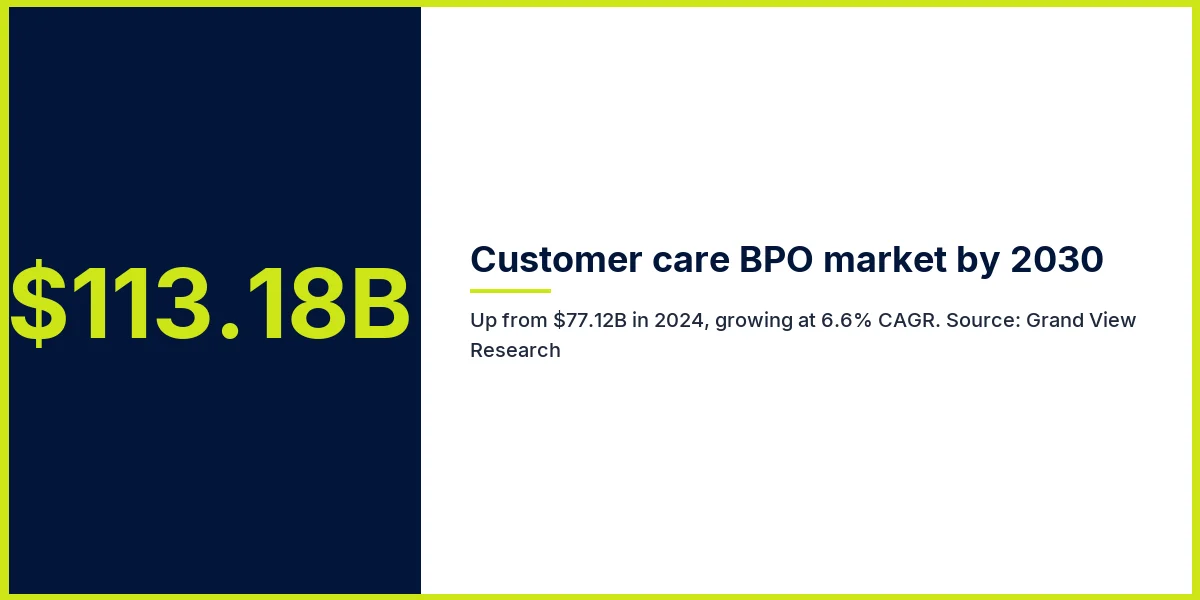
The companies that outsource customer service today aren’t just handing off call volume. They’re delegating entire email queues, chat queues, social media inboxes, and in-app support workflows to specialized partners who operate around the clock. According to Grand View Research, the global customer care BPO market was valued at $77.12 billion in 2024 and is projected to reach $113.18 billion by 2030, growing at 6.6% CAGR. That trajectory reflects decisions made every year by some of the most recognizable brands in the world.
This post is a sector-by-sector reference. For each company listed, you’ll find the channels they outsource, the BPO provider they use (where public evidence confirms it), and why their operation runs this way. One scope note before we start: this list covers email, chat, social, and in-app customer service. If you’re looking specifically at voice-dominant call center operations, that’s a separate scope. The two lists have different brand rosters because the channel mix drives fundamentally different vendor relationships.
Why Major Companies Outsource Customer Service
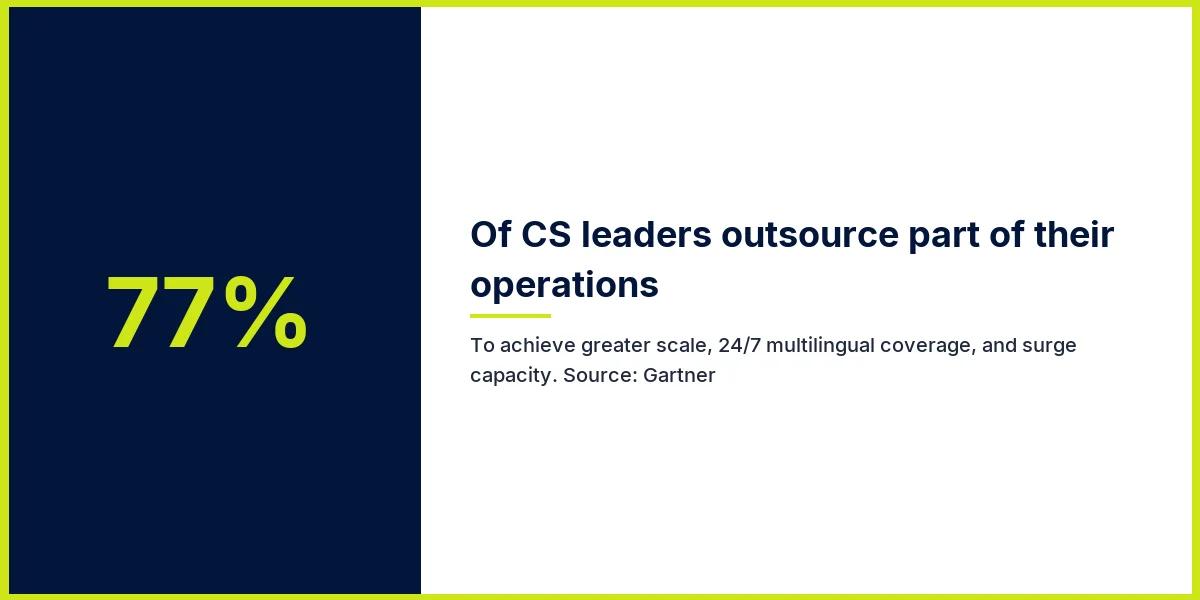
Gartner reports that 77% of customer service leaders outsource some portion of their CS operations to achieve greater scale. The Deloitte 2024 Global Outsourcing Survey found that 50% of executives now outsource front-office capabilities, including customer-facing functions, up from roughly 34% who cite cost alone as the primary driver. The reasons have diversified: 24/7 multilingual coverage, surge capacity management, vendor-managed quality assurance, and access to cost-efficient talent in high-English-proficiency markets are all named drivers.
For the brands in this list, the common denominator is channel complexity. A platform company with 50 million monthly users can’t staff a global email and in-app support queue from a single in-house team without enormous fixed-cost exposure. Outsourcing lets them scale ticket volume with transaction volume, without building and retraining headcount every quarter.
A quick channel note: the companies below outsource across email, chat, social media, and in-app support. Some also outsource voice as one channel among many. For brands where voice is the dominant channel (telecommunications carriers, major US banks, airlines), the vendor relationships look different and the brand lists are intentionally separate.
Tech and SaaS Companies That Outsource Customer Service
Technology companies generate some of the highest support ticket volumes of any sector, driven by product complexity, broad consumer bases, and the expectation of continuous availability. Most run a hybrid model: in-house teams handle escalations and product-specific edge cases, while outsourced partners absorb the channel volume at scale.
Sector: Technology. Channels outsourced: Email and chat support for Google Ads, Google Workspace, and small-business product lines. BPO provider: Accenture and Concentrix have both been cited in industry reporting as Google partners across product verticals; specific vendors have shifted over time. Locations: Philippines, India, Poland.
Google has operated BPO relationships in the Philippines since at least 2011, with partners managing advertiser support, billing inquiries, and account troubleshooting. Advertiser support for Google Ads runs 24/7 and requires multilingual agents covering dozens of markets, which would create fixed cost exposure inconsistent with Google’s lean CS model for self-serve products. For a deeper look at the pros and cons of outsourcing customer service, that post breaks down the trade-offs more fully.
Microsoft
Sector: Technology / Enterprise Software. Channels outsourced: Email, chat, and ticket-based technical support for Microsoft 365, Azure, and consumer products. BPO provider: Concentrix and Infosys are the most publicly documented partners, handling enterprise and consumer support segments respectively. Locations: Philippines, India, Costa Rica.
Microsoft supports hundreds of millions of active users across consumer, small business, and enterprise tiers. Each tier has distinct support complexity and language requirements. Outsourcing the first-contact layer to trained partner agents frees Microsoft’s internal teams for escalation handling and engineering-adjacent support. See the full top customer service outsourcing companies list for a breakdown of the major BPO vendors in this space.
Apple
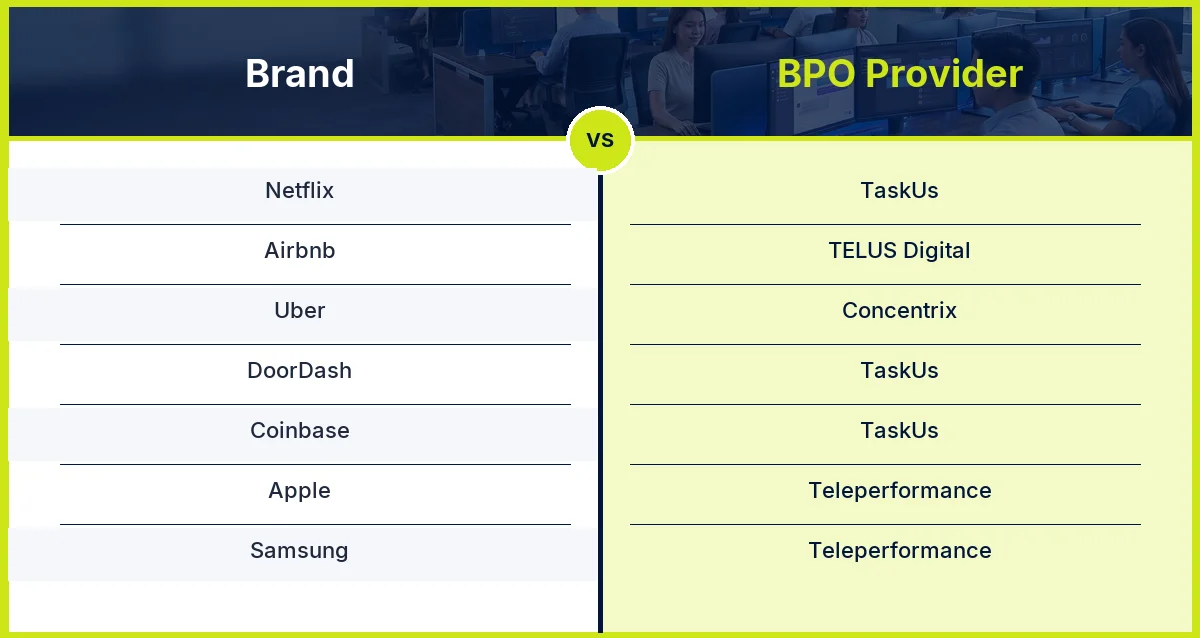
Sector: Technology / Consumer Electronics. Channels outsourced: Chat and email support through Apple’s chat support portal, AppleCare digital channels, and app store billing inquiries. This is distinct from AppleCare phone support, which routes through a separate vendor relationship. BPO provider: Teleperformance handles a significant share of Apple’s digital support channels, separate from its well-documented AppleCare phone contracts. Locations: Philippines, India.
Apple maintains brand consistency across all support channels, including outsourced ones, through detailed training protocols and quality monitoring. The chat and email volume from iPhone, Mac, and services support is large enough to require dedicated external capacity even with Apple’s substantial in-house CS infrastructure.
Zoom
Sector: SaaS / Video Communications. Channels outsourced: Email and chat support for Zoom’s free and Pro tiers, including account management, billing, and basic technical troubleshooting. BPO provider: Zoom’s specific vendor relationships are less publicly documented than those of larger platform companies, so this entry is framed conservatively. What is confirmed: Zoom has used contracted support partners in the Philippines and Latin America for non-enterprise tiers. Locations: Philippines, Latin America.

Zoom’s free-user base is enormous relative to its paying customer count, creating a high-volume, low-revenue support burden that is well-suited to outsourcing. A freemium model with hundreds of millions of registered users means support volume does not track proportionally to revenue. Outsourcing the free-tier queue isolates the cost while protecting internal capacity for enterprise account management.
Hootsuite
Sector: SaaS / Social Media Management. Channels outsourced: Email-based customer support for subscription billing, account issues, and onboarding. BPO provider: Hootsuite’s support operations have included outsourced partners in the Philippines, though the specific vendor is not publicly named in filings or press releases. The company’s job postings and Glassdoor data confirm Philippine-based support roles under contracted arrangements. Locations: Philippines.
SaaS subscription CS is highly process-driven: billing disputes, password resets, plan changes, and cancellation flows follow repeatable paths that outsourced agents can handle with structured playbooks. This frees Hootsuite’s internal team for enterprise customer success and product feedback loops.
Streaming, Gig Economy, and Digital Platform Companies
This is the sector where BPO-provider attribution is most clearly documented in public filings. Platform-economy companies carry enormous support ticket volume driven by transactions, disputes, account safety, and real-time operational needs. The pairings below are sourced from earnings calls, SEC filings, and press releases.
Netflix
Sector: Streaming / Entertainment. Channels outsourced: Email, chat, and in-app support for billing inquiries, account access, streaming troubleshooting, and content questions. BPO provider: TaskUs, per its Q4 2024 financial results announcement, which identifies Netflix as a significant client across content and customer experience verticals. Locations: Philippines, India.
Netflix operates in 190+ countries with subscribers across dozens of language markets. Chat and email support at that geographic scale requires a vendor that can staff multilingual agents across time zones without Netflix building out country-by-country CS infrastructure. TaskUs provides this at scale, with Philippine operations handling a significant share of English-language CS volume.
Airbnb
Sector: Travel / Platform Economy. Channels outsourced: Email, chat, and in-app support for host and guest inquiries, booking disputes, and account issues. Airbnb maintains an in-house team for high-stakes safety and trust cases; outsourced partners handle the volume tier of standard support interactions. BPO provider: TELUS International (now TELUS Digital), which acquired Voxpro in 2017. Voxpro was Airbnb’s primary CS outsourcing agency before the acquisition, and TELUS Digital has continued serving Airbnb’s customer experience operations. Locations: Philippines, Ireland, Canada.
Airbnb’s two-sided marketplace (hosts and guests) creates dual support queues with distinct issue types, seasonal surge patterns around major travel periods, and multilingual requirements across a global user base. The hybrid model lets Airbnb keep judgment-intensive cases close while routing predictable volume through TELUS Digital’s infrastructure.
Uber
Sector: Gig Economy / Transportation. Channels outsourced: In-app support, email, and chat for rider and driver inquiries, trip disputes, refunds, and account issues. BPO provider: Concentrix is the most commonly reported partner in Glassdoor and LinkedIn employee disclosures from BPO agents working on Uber accounts, primarily in the Philippines. This pairing is framed as publicly reported by employees rather than confirmed through a press release or SEC filing, so treat it as strongly evidenced but not formally verified. Locations: Philippines, India.
Uber’s real-time operations create a continuous support queue. Driver earnings disputes, rider safety reports, and fare adjustments require fast resolution across time zones, and outsourced agents operating in the Philippines provide the 24/7 coverage that keeps resolution times competitive.
DoorDash
Sector: Gig Economy / Food Delivery. Channels outsourced: Chat, email, and in-app support for customer order issues, Dasher inquiries, and merchant support. BPO provider: TaskUs, which has disclosed DoorDash as one of its largest revenue concentrations across its earnings filings on the SEC EDGAR system, where DoorDash has appeared as a top-ten client. Locations: Philippines, India.
Food delivery support is high-frequency and time-sensitive. Order status, missing items, refund requests, and Dasher payment issues are volume-driven, repeatable ticket types that outsourced agents handle through structured escalation paths without requiring deep product knowledge.
Coinbase
Sector: Fintech / Cryptocurrency. Channels outsourced: Email and chat support for account verification, transaction inquiries, fraud reports, and general customer questions. BPO provider: TaskUs, cited as a major client in their financial services vertical per earnings call transcripts covering TaskUs’s quarterly disclosures. Locations: Philippines, India.

Coinbase’s support volumes are heavily driven by market volatility: during crypto price spikes, ticket volume can increase severalfold within hours. Crypto CS requires agents trained on compliance-sensitive topics (ID verification, account security, fraud triage) combined with the ability to surge capacity rapidly during market events. TaskUs’s Philippine operations provide both the compliance training infrastructure and the scalable headcount.
E-Commerce and Retail Brands That Outsource Customer Service
Retail and e-commerce CS is driven by transaction volume, returns, and order status inquiries. These brands need high-capacity email and chat coverage, often with seasonal surges around major shopping events. The channel mix is predominantly non-voice for standard transactions, with voice reserved for escalations.
Amazon
Sector: E-Commerce / Technology. Channels outsourced: Email, chat, and returns processing CS for Amazon Marketplace sellers and buyers. This entry covers the email and chat layer rather than Amazon’s high-volume call center operations, which are covered separately in our cluster. BPO provider: Amazon operates dedicated offshore CS centers in the Philippines and India under its own brand, in addition to contracting third-party BPO vendors for overflow capacity. Locations: Philippines, India.
Amazon’s returns and refund volume alone generates millions of CS contacts monthly. Processing these at scale requires a combination of internal operations and outsourced capacity that can flex with Prime Day, Black Friday, and other sales events. For a closer look at e-commerce CS specifically, see our ecommerce customer service outsourcing page.
Walmart
Sector: Retail / E-Commerce. Channels outsourced: Email and chat support for Walmart.com orders, Walmart+ membership inquiries, and online return processing. Walmart’s brick-and-mortar locations handle in-store CS, while digital channel support for online orders runs through outsourced partners. BPO provider: Teleperformance and Concentrix have both been reported in industry coverage as partners for segments of Walmart’s customer support operation. Walmart has not formally confirmed either pairing in SEC filings, so treat these as industry-reported rather than company-disclosed. Locations: Philippines, India.
Walmart.com’s transaction volume is comparable to other major US e-commerce platforms. Handling order inquiries, refund requests, and account issues for a marketplace of that size requires outsourced capacity that can absorb seasonal surges without affecting in-store operations.
Target
Sector: Retail / E-Commerce. Channels outsourced: Email and chat support for Target.com orders, Target Circle loyalty inquiries, and online return assistance. BPO provider: Concentrix has been named in industry reporting as a partner for portions of Target’s CS operation, though this pairing is not confirmed in Target’s own SEC filings or press releases. Treat as industry-reported rather than company-disclosed. Locations: Philippines, India.
Target has invested heavily in digital commerce infrastructure, and its outsourced CS operation reflects that shift toward online transaction support. Target Circle, with over 100 million members, creates a high volume of rewards, points, and offer-related CS contacts that run parallel to standard order support. Managing both streams with internal-only staffing would require significant fixed headcount that outsourcing avoids.
Samsung
Sector: Consumer Electronics. Channels outsourced: Email, chat, and in-app support for Samsung devices, Galaxy ecosystem products, and warranty inquiries. BPO provider: Teleperformance, which lists Samsung among its consumer electronics clients in annual reports and public case studies. Locations: Philippines, India, Colombia.
Samsung sells devices across 180+ countries, generating CS contacts in dozens of languages across product lines that span smartphones, televisions, home appliances, and wearables. Teleperformance’s multilingual delivery infrastructure handles this scope without Samsung building country-by-country CS teams.
Financial Services and Subscription Brands That Outsource Customer Service
Financial services and subscription businesses face a distinct CS challenge: their customers have high stakes and low tolerance for error. The brands below outsource carefully, often keeping regulated or sensitive case types in-house while routing standard inquiries through vetted external partners.
American Express
Sector: Financial Services / Premium Credit. Channels outsourced: Email and chat support for card member inquiries, rewards questions, travel benefits, and account management. BPO provider: American Express has maintained outsourced CS relationships with multiple partners including Concentrix, with the Philippines as a primary delivery location across their cardholder support functions. Locations: Philippines, India, US.
American Express is known for premium CS standards, and its outsourcing model reflects that: partners are selected for quality consistency, not just cost. AmEx manages one of the most complex CS portfolios in financial services, with Platinum cardholders, business accounts, and travel concierge services all requiring different agent training and escalation paths. Outsourced partners handling standard email and chat inquiries free internal teams to manage high-value member relationships and escalations.
Principal Financial Group
Sector: Financial Services / Retirement and Insurance. Channels outsourced: Email and digital support for retirement account inquiries, benefits questions, and policy administration. BPO provider: Principal has worked with Accenture as an outsourcing partner for business process functions, including customer-facing roles in the Philippines. Locations: Philippines.

Retirement and benefits CS is complex and regulated, which means the outsourced partner must meet compliance requirements for financial services data handling. HIPAA-adjacent data (for group health plans), GDPR (for international clients), and Philippines DPA compliance are all relevant for a partner operating in this context.
Wall Street Journal
Sector: Media / Subscription Publishing. Channels outsourced: Email and chat support for WSJ digital subscriptions, billing inquiries, access troubleshooting, and cancellation management. BPO provider: Dow Jones (WSJ’s parent) has used outsourced CS partners for subscription management functions, with India and the Philippines among the documented delivery locations, though specific current vendor names are not publicly disclosed in recent filings. Locations: India, Philippines.
Subscription CS for a major publication is process-driven: billing disputes, password resets, and offer redemptions follow predictable paths. A subscription business with millions of digital subscribers generates a high-volume, low-complexity CS queue for standard account management. Outsourcing this layer keeps internal editorial and product teams focused on the content side.
EasyJet
Sector: Travel / Low-Cost Aviation. Channels outsourced: Email, chat, and social media CS for booking inquiries, disruption management, loyalty program (EasyJet Plus) support, and claims. BPO provider: EasyJet has contracted with Teleperformance for portions of its customer contact operations. Locations: South Africa, Philippines, Eastern Europe.
EasyJet adds geographic breadth to this list as a UK-based carrier that operates significant CS outsourcing through partners across multiple regions. Low-cost carrier CS is volume-heavy and seasonally variable. Flight disruptions, rebooking requests, and EU261 compensation claims create unpredictable surge periods that fixed in-house teams cannot absorb without significant overstaffing in off-peak periods. Outsourced partners absorb the surge and right-size staffing between peaks.
What These Companies Have in Common
Across every sector above, four patterns repeat. These aren’t generalizations; they’re the structural reasons why brands at this scale choose to outsource rather than build.
Digital-first channel mix. None of these companies outsource voice as their primary channel. Email, chat, social, and in-app support are the channels that drive their outsourcing decisions. Voice is part of the mix for some, but the strategic shift has been toward written channels where response quality can be monitored more systematically and at higher volume.
24/7 multilingual coverage without fixed-cost headcount. A company serving customers across 50 countries cannot staff a round-the-clock, multilingual CS team from a single internal hub without enormous fixed cost exposure. Outsourced partners in the Philippines, India, and Latin America provide the geographic distribution needed to cover time zones and language markets.
Surge capacity as a structural requirement. Platform economy companies (Uber, DoorDash, Coinbase) and retail brands (Amazon, Target) both experience sharp volume spikes around events: market moves, sales periods, service outages. Outsourced teams can scale up and down with those events in ways that internal headcount cannot.
Vendor-managed quality assurance. The brands above don’t just hand off work. They specify quality metrics, require calibration sessions, and run their own QA audits on outsourced interactions. The outsourced model works at this scale because the vendor is accountable to measurable outcomes, not just availability.
When Outsourcing Doesn’t Work: Reshoring, Hybrid Models, and What to Watch
The Sage position on outsourcing is not advocacy. Several patterns in this data are worth naming honestly.
Airbnb keeps its highest-stakes safety and trust cases in-house deliberately. When a guest reports a safety incident or a host faces account suspension, the sensitivity and judgment required exceeds what a scripted outsourced workflow can handle. Many platform-economy companies run this same hybrid: outsourced partners absorb standard volume, internal teams own the cases that carry legal or reputational risk.
Financial CS faces real regulatory pressure. Principal Financial Group and American Express both operate in heavily regulated environments where data handling, compliance documentation, and agent certification requirements constrain how easily CS work can be shifted offshore. The outsourced partners they use are vetted specifically for compliance posture: HIPAA-relevant data handling (for group health plans), GDPR compliance (for EU customers), and Philippines Data Privacy Act alignment (for Philippine delivery locations). Compliance is not optional in these sectors; it’s a vendor selection criterion.

Reshoring is real but partial. Some companies have brought specific CS functions back in-house, particularly for markets where language quality was inconsistent or brand standards weren’t being met. But partial reshoring is not the same as a broad retreat from outsourcing. The companies listed above are still outsourcing the bulk of their CS volume. What has changed is the selectivity: brands are now more deliberate about which ticket types go to outsourced partners and which stay internal.
What to Look for in a Customer Service Outsourcing Partner
The brands above chose their partners based on criteria that go beyond cost. Four stand out across the sector patterns in this list.
Track record at your scale. A vendor that has built teams for Fortune 500 companies may not be the right fit for a company with 10,000 monthly support contacts. And a vendor optimized for small accounts may not have the infrastructure to absorb a volume surge. The match between your transaction scale and the vendor’s operational track record matters more than brand recognition.
Channel coverage that matches your actual needs. The companies in this post outsource email, chat, social, and in-app support. Not all BPO vendors have equal capability across these channels. A vendor built around phone support may not have the quality monitoring infrastructure to manage chat volume at the standard your customers expect.
Compliance posture relevant to your industry. For financial services, healthcare-adjacent accounts, or any operation touching EU customers, the vendor’s compliance certifications and data handling practices are selection criteria, not afterthoughts. Partners should be able to document their HIPAA-relevant practices, GDPR compliance, and Philippines Data Privacy Act alignment where applicable.
Vendor retention metrics, not just agent availability. High agent turnover at a BPO vendor means your customers interact with undertrained agents more often than your quality standards allow. Ask prospective partners for their agent retention rate. Digital Minds BPO, a Philippine-based business process outsourcing company with 15+ years of CS operations across three facilities in Naga City, maintains a 94% client retention rate and an average partnership of 4.7 years, which reflects the stability of the teams we build for each client. Learn more about our customer service outsourcing model.
FAQ: Companies That Outsource Customer Service
Do companies outsource their customer service?
Yes. Gartner reports that 77% of customer service leaders outsource some portion of their CS operations. The practice spans every major sector: technology, e-commerce, financial services, streaming platforms, and gig economy companies all rely on outsourced partners for email, chat, social, and in-app customer support at scale.
How much does outsourced customer service cost?
Pricing depends on the channel type, agent tier, and volume. Non-voice customer service (email, chat, social) typically starts around $924 per agent per month through a Philippine BPO, while voice-dominant support starts slightly higher. That compares to $4,000-$5,000 per month for a comparable in-house agent in the US when you factor in salary, benefits, and overhead. The actual cost of outsourcing customer service depends on scope, team size, and the channels you need covered.
Does Target outsource customer service?
Yes. Target outsources email and chat support for Target.com orders, Target Circle loyalty inquiries, and online return assistance. Concentrix is among the vendors reported to handle portions of Target’s CS operation, with the Philippines as a primary delivery location. Target’s in-store CS remains internal; the outsourced layer covers digital channel volume for its e-commerce business.
Does Amazon outsource its customer service?
Amazon uses a hybrid model. It operates its own dedicated offshore CS centers in the Philippines and India under the Amazon brand, and it also contracts third-party BPO vendors for overflow capacity during peak periods. Amazon’s email and chat support for Marketplace sellers and buyers runs through this combined internal-plus-outsourced infrastructure. The company does not rely on a single external vendor; it manages CS capacity through multiple channels simultaneously.
Does Apple outsource customer service?
Yes. Apple outsources both phone (AppleCare) and digital (chat and email) customer support to external partners. Teleperformance handles a significant share of Apple’s chat and email support channels, in addition to its well-documented AppleCare phone contracts. Apple’s outsourced CS teams operate under strict quality protocols and brand guidelines, which is why the support experience feels consistent across channels even when delivered by an external partner.
Which BPO does Netflix use for customer service?
Netflix uses TaskUs as a primary BPO partner for customer experience functions. TaskUs disclosed Netflix as a significant client in its Q4 2024 earnings call, citing work across content moderation and customer support verticals. Netflix’s CS needs are driven by its global subscriber base across 190+ countries, which requires multilingual support across email and chat channels that TaskUs’s Philippine and Indian operations provide.
Does Airbnb outsource its customer service?
Yes, partially. Airbnb outsources the volume tier of its CS operations (booking inquiries, account issues, standard guest and host support) through TELUS International, which acquired Airbnb’s original CS agency Voxpro in 2017. High-stakes cases involving safety incidents, platform trust violations, and complex disputes are handled by internal Airbnb teams. The hybrid model is intentional: outsourced partners absorb scale, internal teams retain judgment-intensive case types.
What is the difference between outsourcing a call center and outsourcing customer service?
Outsourcing a call center refers specifically to voice-based phone support operations, where agents handle inbound and outbound calls. Outsourcing customer service is broader: it covers email, chat, social media, in-app messaging, and voice as one channel among many. The vendor relationships, pricing structures, and operational requirements differ between the two. Most of the brands in this post outsource multi-channel customer service, not just call center volume. Voice-dominant call center outsourcing follows a separate pattern, with different brand rosters and vendor relationships.

Sofia Reyes is a Content Writer and SEO Specialist at Digital Minds BPO, where she focuses on outsourcing-industry research and educational content for business decision-makers. Based in the Philippines, she has 7 years of experience writing B2B content across SEO, content strategy, and Generative Engine Optimization (GEO). Sofia partners with Digital Minds BPO’s operations and account management teams to translate 15+ years of frontline BPO experience into clear, sourced guides on call center, customer service, and back-office outsourcing. Her work supports prospects evaluating outsourcing decisions across the company’s three dedicated facilities, where the team delivers a 94% client retention rate for clients ranging from Fortune 500 enterprises to growth-stage businesses.