Companies that outsource successfully share a short list of decisions. Those that struggle share the opposite ones. After 15 years running Digital Minds BPO in Naga City, Philippines, I’ve seen both outcomes more times than I can count, and the difference almost never comes down to which vendor a company chose.
It comes down to how they approached it.
The companies winning at outsourcing in 2026 are not necessarily the biggest. Google, P&G, and Nike outsource because their scale demands it. But mid-sized companies in the $5M to $50M range use outsourcing the same way and get proportional results. What they have in common: they treat outsourcing as an operational decision, not a cost-cutting exercise. They define scope before signing. They track KPIs from day one. And they invest in the relationship the same way they would with a key internal hire.
This post covers which companies outsource and what they hand off, why they do it (the data is more interesting than you’d expect), where they go, and what separates the engagements that hold for years from the ones that quietly fall apart after six months.
Why Companies Outsource: The Data Beyond Cost
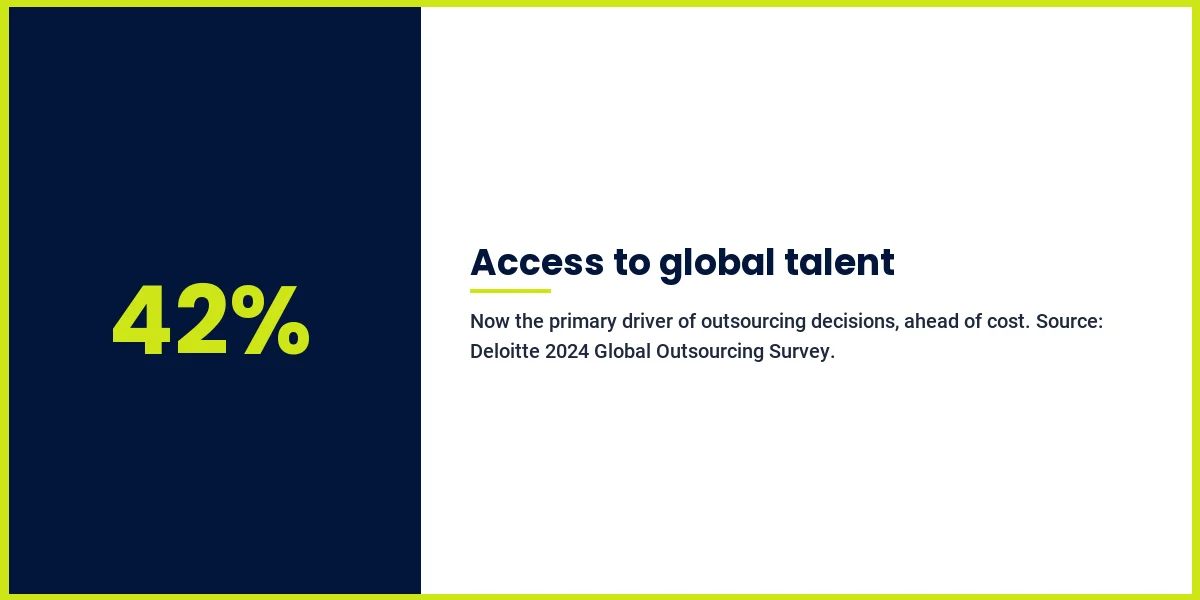
The standard narrative is that companies outsource to cut costs. That is part of the picture. But Deloitte’s 2024 Global Outsourcing Survey puts a number on something experienced operators already know: 42% of companies now cite access to global talent as the primary driver, ahead of cost reduction. Talent scarcity, not price arbitrage, is the lead motivation for nearly half of all outsourcing decisions today.
The same survey found that 83% of companies expect AI capability integration from their outsourcing partners. And 32% use a multi-vendor model, spreading different functions across specialized providers rather than consolidating everything under one roof. These are not signals of cost-hunting. They are signals of strategic sourcing.
A separate analysis from Fieldfisher, the international law firm that handles a significant volume of outsourcing contract work, found that 75% of companies outsource to access advanced technology they cannot build or buy in-house, 69% cite cost efficiency, and 56% want service optimization: the ability to reach a consistent quality standard faster than they could build it internally.
What this tells me: cost is a factor in almost every outsourcing decision, but it is rarely the only factor in a good one. The companies that approach outsourcing purely as a wage play tend to get what they pay for. The companies that approach it as an operational capability build, accessing talent, technology, and process expertise they couldn’t develop on their own timeline, tend to see the results that justify long-term partnerships.
The Functions Companies Outsource Most
Not every business function is a candidate for outsourcing. But some translate consistently well, across industries and company sizes. Here are the ones companies hand off most often, and what to know about each.
Customer Service
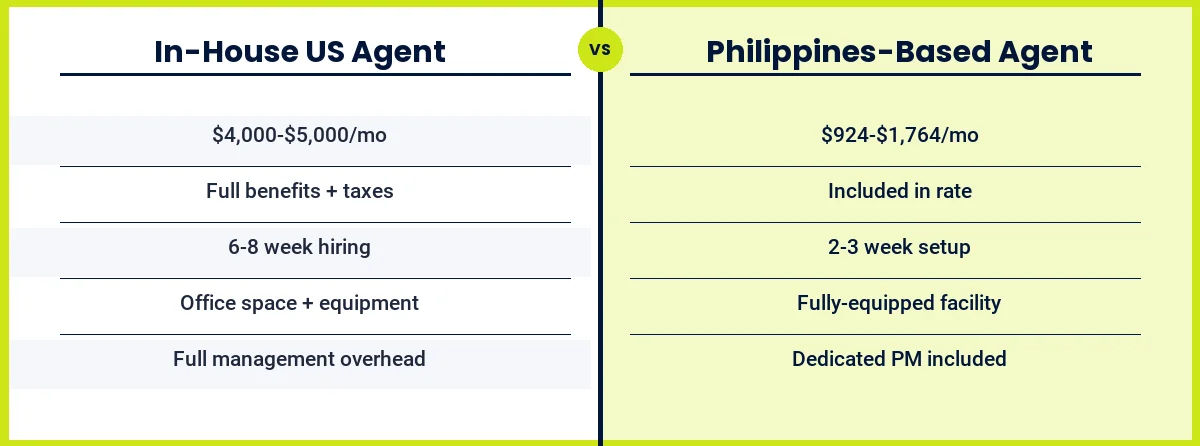
Customer service outsourcing is one of the most common starting points for companies exploring BPO for the first time. The function is well-defined, the KPIs are measurable (CSAT, first-contact resolution, average handle time), and the cost differential between in-house and outsourced teams is significant. A US-based customer service agent costs $4,000 to $5,000 per month in total employment cost. A dedicated agent in the Philippines runs $924 to $1,764 per month depending on the tier and function. Most companies running outsourced customer service teams do not notice a quality difference within 90 days of a well-structured transition. Their customers notice nothing at all.
For a detailed look at which companies outsource customer service and how they structure it, see our post on companies that outsource customer service.
Call Centers
Inbound call center outsourcing sits adjacent to customer service but covers a broader scope: technical support lines, order management, appointment scheduling, and dispatch. The Philippines is the global leader in voice-based BPO for English-speaking markets, a position built over three decades of investment in telecommunications infrastructure, English-medium education, and workforce training programs. Our guide to companies that outsource call centers covers the setup, the KPIs, and the company examples in detail.
IT and Technical Support
IT outsourcing runs from Level 1 help desk (password resets, basic troubleshooting) all the way to software development and managed infrastructure. Large technology companies outsource IT at scale: Google runs significant engineering work through contracted development teams across India and Mexico. Microsoft partners with firms like Wipro for AI and solutions development. Smaller companies use IT outsourcing to extend their internal teams without adding headcount. See our coverage of companies that outsource IT for the full breakdown.
Human Resources
HR outsourcing covers recruitment support, onboarding administration, benefits management, and compliance documentation. Companies that outsource HR functions typically retain strategic HR decisions in-house while handing off the administrative volume. This is a natural fit for companies scaling fast: the administrative burden of adding 20 people per quarter is real, and it doesn’t require an internal HR director to resolve it. Our companies that outsource HR post covers the specific functions and how companies structure the split.
Payroll
Payroll outsourcing is one of the cleaner outsourcing decisions a company can make. The function is rule-based, compliance-sensitive, and carries real penalty risk if done incorrectly. Many mid-sized companies run payroll through a third-party provider from day one and never build the internal capacity, because the specialization required isn’t worth developing internally. Companies that outsource payroll, from small businesses to Fortune 500 firms, consistently cite accuracy and compliance coverage as the primary return on the decision.
Data Entry and Back Office
Data entry, document processing, and back-office administration are high-volume, repetitive functions that do not require on-site presence and translate well to outsourcing. The accuracy standards are high and verifiable; the cost savings are material. For companies handling large volumes of records, claims, or transaction data, outsourcing this function to a dedicated team with quality controls in place is significantly more reliable than managing it through internal staff who are splitting attention across other priorities. See companies that outsource data entry for examples and setup guidance.
Manufacturing and Physical Operations
Physical manufacturing outsourcing is a different category from BPO. It involves contract manufacturers and supply chain partners rather than knowledge-work teams. Nike produces the vast majority of its footwear through contract manufacturers in Vietnam, Indonesia, China, the Philippines, and Taiwan, as documented in the company’s annual reports. Pfizer worked with over 200 contract manufacturers across its supply chain during COVID-19 vaccine production. Apple’s relationship with Foxconn for iPhone assembly is probably the most cited example in business writing. These arrangements involve their own governance, IP protection, and quality management considerations that differ substantially from service-based outsourcing.

Notable Companies That Outsource (By Industry)
The following examples are organized by industry. For each, I’ve noted what they outsource and, where the information is publicly documented, who their outsourcing partners are. Attribution quality matters to me: I’ve only included examples backed by company disclosures, documented transactions, or credible reporting. Uncited claims that circulate on content aggregator sites are not here.
Technology
Google (Alphabet) has used outsourced development teams for QA, software development, and customer support across its products. Alphabet’s investor disclosures show a company with revenues and operating income that have grown substantially (Q4 2024 operating income was up 31% year-over-year), built on a workforce model that includes contracted specialists in India, Mexico, and the Philippines alongside its direct employee base. Google’s internal nomenclature for these workers (“TVCs”: temps, vendors, and contractors) reflects how central this model is to its operations.
Meta outsources content moderation at scale. Accenture is one of the documented partners, handling moderation across multiple languages and markets. Content moderation at Meta’s volume requires thousands of specialized reviewers operating around the clock; building that internally would not be operationally practical.
Microsoft partners with Wipro and other Global System Integrator partners for AI and machine learning development work, as well as solutions advocacy for enterprise clients. Microsoft’s partner ecosystem is a deliberate part of its go-to-market structure, not a cost-reduction measure.
WhatsApp, before Meta’s 2014 acquisition, ran on outsourced infrastructure from IBM, Twilio for communications, Zendesk for support, and Cloudflare for network security. A company of 55 employees serving 450 million users built its technical foundation on specialized vendors. That ratio is cited routinely because it illustrates what focused outsourcing can enable at startup scale.
Slack used Datadog for infrastructure monitoring and outsourced parts of its cloud operations. Spotify runs on Google Cloud infrastructure, with CDN services through Fastly and Akamai, and payment processing through Adyen and Stripe. These are not edge cases. They are standard operating models for technology companies that want to build product without building every underlying layer.
IBM is interesting because it sits on both sides of this picture. IBM outsources some of its own software development and legacy infrastructure work to Infosys, Tata Consultancy Services, and HCL. In 2021, IBM spun off its managed infrastructure services division into a separate company, Kyndryl, which now operates as an independent IT services provider. IBM outsourcing to others while also being outsourced to by others is a clean illustration of how mature this model has become in the technology sector.
Financial Services
American Express established one of the earliest offshore customer support operations, opening a processing center in India in 1994. That operation grew substantially over three decades and now covers customer service, collections, and transaction processing. American Express has been careful about where it places regulated work versus operational support, a distinction that matters in financial services.
Citigroup has operated outsourced customer service and IT support teams across the Philippines and India for years. Banking operations at Citi’s scale require large-volume contact center capacity that would be prohibitively expensive to staff entirely in US or UK markets.
One note on Wells Fargo: a specific headcount number for its Philippine operations circulates widely across BPO content without a traceable primary source. If you are researching this for a business decision, go to Wells Fargo’s own disclosures rather than aggregated secondary claims.
Retail and Consumer Goods
Procter & Gamble executed one of the most documented outsourcing transactions in corporate history. In 2003, P&G signed agreements with Jones Lang LaSalle (facilities management), IBM (IT), and Hewlett-Packard (IT services) totaling approximately $4.2 billion. The scale of that transaction, and the documented vendor names, make it one of the clearest examples of what large-enterprise outsourcing looks like at execution. P&G is also a client of Digital Minds BPO, specifically for administrative support functions in the Philippines.
Nike manufactures the vast majority of its footwear and apparel through contract manufacturers rather than owned facilities, a model it has sustained for decades. Nike’s annual reports document its manufacturing country mix and the governance structure it applies to contract manufacturers. The company treats supplier relationships as long-term partnerships with clear standards, not as a cost-minimization exercise. That framing is consistent across Nike’s ESG reporting.
Healthcare and Pharma
UnitedHealth Group, one of the largest healthcare companies in the world by revenue, outsources portions of its IT operations, healthcare records management, and analytics processing. Healthcare BPO requires specific compliance coverage under HIPAA, which has pushed the industry toward outsourcing partners with documented security protocols rather than general-purpose vendors.
Pfizer works with over 200 contract manufacturers across its global supply chain. The COVID-19 vaccine production timeline accelerated Pfizer’s use of contract manufacturing organizations (CMOs) substantially, compressing a development and production process that would normally take a decade into roughly 18 months. The documented scale of that operation is one of the clearest arguments for what outsourcing enables when the alternative, building all manufacturing capacity internally, is not viable on the required timeline.
Government and Infrastructure
Government agencies outsource more than most people realize. In the Philippines, the Bureau of Customs works with Digital Minds BPO on data entry and administrative processing. That relationship reflects a pattern common across government: agencies face volume challenges that their internal staffing models cannot address, and BPO partnerships offer a structured solution without permanent headcount commitments. We’ve supported the Bureau of Customs for several years, and the engagement is one of our most consistent in terms of process compliance and delivery accuracy.
Where Companies Outsource To
Geography matters in outsourcing, but not for the reasons most content on this topic suggests. Time zone alignment, language capability, and cultural proximity to the client market all affect how well a partnership functions day to day. So does the maturity of the local BPO industry, which determines how much process expertise exists in the talent pool before your team is trained.
The Philippines is the global leader for English-language voice-based BPO, a position it has held for over 20 years. The combination of neutral American-accented English, a college-educated workforce, and an established BPO industry with government investment in training and infrastructure makes it the default destination for US, Australian, and UK companies outsourcing customer-facing functions. For a detailed look at outsourcing to the Philippines, including the honest trade-offs alongside the advantages, that post covers it thoroughly.
India remains the dominant destination for IT outsourcing, software development, and finance and accounting. India’s BPO industry is larger than the Philippines by revenue, and its technical talent pool is deeper in engineering and data science disciplines. The Philippines has closed the gap in non-voice back-office work but has not displaced India’s position in IT services.
Mexico and Colombia have grown substantially as nearshore destinations for US companies that want Spanish-language capability or reduced time-zone distance. Mexico City’s growing tech sector and Colombia’s strong English-language program expansion have made both viable for mid-market companies that find offshore time zones difficult to manage.
Eastern Europe (Poland, Romania, Ukraine before 2022, and increasingly Bulgaria and the Czech Republic) serves European clients primarily, with strong technical talent in software development and a working culture that aligns well with German and Nordic business expectations.
For US companies specifically, the Philippines consistently offers the strongest combination of English fluency, cultural alignment with US communication styles, cost efficiency, and government-backed workforce programs. Australian companies have a similar profile. For our analysis of US companies that outsource, including which industries are most active, that post covers the data in detail.
What Separates Successful Outsourcing Partnerships
I have been running outsourcing partnerships for 15 years. What consistently separates the engagements that hold for years from the ones that end earlier than expected is rarely the vendor. It is almost always the setup.
Digital Minds BPO has a 94% client retention rate and an average partnership duration of 4.7 years. Those numbers matter to us. They are also unusual in an industry where annual churn is a common problem. Understanding why they hold gives you a useful framework for evaluating any outsourcing arrangement, not just ours.
Scope definition before anything else. The partnerships that struggle most often started with vague expectations. “We need someone to handle customer support” is not a scope. A scope specifies volumes, channels, escalation paths, quality thresholds, reporting cadence, and what happens when those thresholds aren’t met. Companies that define this before signing almost always have a smoother first 90 days. Companies that define it after, or worse, after the first quality issue surfaces, spend those 90 days in a different kind of conversation.
KPI structure from day one. If you can’t measure it, you can’t manage it. Every engagement at Digital Minds BPO starts with a set of baseline metrics: what does success look like at 30, 60, and 90 days? What triggers a review? What triggers a conversation about headcount or process changes? Companies that come in with this clarity get better outcomes, because both parties know what they’re working toward.
Cultural integration, not cultural tolerance. The companies that treat their outsourced team as a separate entity, managed at arm’s length through dashboards, tend to get a transactional relationship. The companies that bring their outsourced team into their communication culture, share context on company direction, and treat agents as extended team members tend to see higher performance and lower attrition. This is not soft advice. It translates directly to CSAT scores and handling time metrics within six months.
Retention design. In most BPO arrangements, client companies don’t think about agent retention because it feels like the vendor’s problem. In our experience, it’s shared. Clients who invest in recognition programs, performance bonuses routed through us, and periodic direct communication with their team see meaningfully lower attrition than those who don’t. For what the industry numbers actually say, and which widely quoted attrition figures do not survive a source check, see our call center turnover and attrition statistics. Our average partnership duration of 4.7 years is partly a function of this: clients who stay that long have built something with their team that they’re not willing to discard.
Right-sized from the start. One pattern we see repeatedly: a new client starts with three agents because they’re cautious, the team performs well, and 12 months later they want 20. That’s a good problem to have. We’ve built single-client teams of 50 to 100 agents and scaled further from there. The transition from small to large works best when the original scope was designed with growth in mind. A scope built for three agents often needs to be redesigned, not just expanded, when the team reaches 20.
What Companies Should Not Outsource
An honest guide to outsourcing has to include this section. Not everything should be outsourced, and the companies that try to outsource everything usually end up regretting parts of the decision.

Core IP and proprietary methods. If your competitive advantage lives in a process, a formula, or a methodology that you’ve spent years developing, outsourcing the work that executes that process creates IP exposure. This is especially true if the outsourcing arrangement involves sharing detailed operational documentation with a third party who also works with your competitors. There are ways to structure around this, but it requires careful contract design and is not a default-safe outsourcing candidate.
Strategic decision-making. Outsourcing execution is sound. Outsourcing judgment is not. The decisions that determine where your company goes, market positioning, product direction, client relationship management at the senior level, pricing strategy, should stay internal. External experts can inform those decisions. They should not make them.
Brand voice for public-facing content. This is a more nuanced one. Many companies outsource content production, and it works well when the brand voice is documented in sufficient detail for an external team to follow. Where it fails is when a company expects an external content team to develop the brand voice rather than execute it. Brand voice is an internal product. External execution is possible. External development of what your company sounds like is not outsourcing; it’s abdication.
Highly regulated functions without a compliance framework in place. Healthcare companies, financial services firms, and legal businesses face compliance requirements that an outsourcing arrangement does not eliminate. HIPAA, GDPR, PCI DSS, and similar frameworks still apply to your vendor’s handling of your data. If you cannot audit compliance, document your oversight protocol, or verify that your vendor meets the applicable standard, outsourcing that function is a regulatory risk. Build the compliance framework before you move the work, not after.
How to Choose an Outsourcing Partner
Choosing an outsourcing partner is more consequential than most companies realize during the evaluation stage. The decision will shape your customers’ experience, your internal team’s workload, and your operational risk profile for years. A few criteria I would put at the top of any evaluation:
- Retention data, not just pitch decks. Ask any prospective vendor for their client retention rate and average partnership duration. If they don’t track these numbers, that tells you something. If they do and won’t share them, that tells you something else. Both are useful data points.
- References from clients at your size. A vendor who works primarily with Fortune 500 companies will not give the same attention to a five-agent engagement that a mid-market-focused firm will. Ask for references from clients with similar headcount to what you’re starting with.
- Security and compliance documentation. Not a general assurance of compliance. Actual documentation: ISO certifications, data protection protocols, background check procedures, physical security measures at the facility. Any reputable vendor can provide this without hesitation.
- Pilot structure. A vendor confident in their delivery will offer a structured pilot period with defined success criteria. If the pitch skips straight to a long-term contract, slow down.
- Named account management. Who is your contact after the contract is signed? Is it a senior person who was in the sales conversation, or is it a coordinator you’ve never spoken to? The handoff from sales to delivery is where many outsourcing relationships lose momentum in the first 30 days.
For a deeper look at what Digital Minds BPO offers across customer service, call center, and back-office functions, our services overview covers the specific capabilities and how engagements are structured. If you’re evaluating customer support outsourcing specifically, our customer support outsourcing page goes into the setup detail.
Frequently Asked Questions
What is the difference between outsourcing and BPO?
Outsourcing is the broader term: any arrangement where a company contracts an external party to perform work that could have been done internally. Business process outsourcing (BPO) is a specific category focused on ongoing business processes, such as customer service, data entry, payroll, and HR administration, rather than one-time projects or specialized professional services. All BPO is outsourcing, but not all outsourcing is BPO. A company hiring a consultant to design a new compensation structure is outsourcing; a company contracting a dedicated team to run its payroll processing ongoing is BPO. The distinction matters because BPO relationships are typically governed differently, with longer terms, defined SLAs, and dedicated team structures rather than project-based engagement models.
What are the biggest US companies that outsource to the Philippines?
The largest US companies with documented operations in the Philippines include Citigroup, JPMorgan Chase, American Express, Accenture (which both delivers and administers outsourcing services there), and healthcare companies including UnitedHealth Group. Technology companies with Philippine operations include Meta, which uses Philippine-based content moderation teams. Procter & Gamble, as noted above, is a Digital Minds BPO client for administrative support. For a detailed breakdown of US companies active in the Philippine BPO market, our post on which US companies outsource to the Philippines covers the specific industries and functions in depth.
How much do companies save by outsourcing?
The range cited most often is 40% to 70% on labor costs, depending on the function and destination. For customer service and call center work to the Philippines specifically, a US-based agent at $4,000 to $5,000 per month in total employment cost compares against a Philippine-based agent at $924 to $1,764 per month, depending on the role and tier. That’s roughly 60% to 70% on the labor line. Companies that account for transition costs, management overhead, and the time investment required to set up a partnership correctly often land at 50% to 60% net savings in the first year, with the margin widening as the team matures. The savings compound: a company that outsources a team of 10 and grows it to 30 over three years captures those savings at scale while the internal overhead of managing the team grows more slowly than headcount.
Which industries outsource the most?
Technology and financial services have historically been the heaviest users of outsourcing by dollar volume. Retail and consumer goods outsource manufacturing at large scale. Healthcare is a growing segment, driven by administrative volume, billing complexity, and cost pressure on health systems. Government and public sector outsourcing is substantial but less visible because it doesn’t generate the same press coverage as corporate deals. In terms of BPO specifically (knowledge work and customer-facing functions rather than manufacturing), the Philippines’ top client sectors are US financial services, US and Australian healthcare, e-commerce and retail support, and technology companies of all sizes. The BPO companies in the Philippines post covers the industry distribution in more detail.
What is the difference between outsourcing and offshoring?
Offshoring refers specifically to moving work to another country, whether through a third-party vendor or through a company’s own subsidiary or captive center in that country. Outsourcing refers to contracting work to an external party, which may or may not be in another country. A company that sets up its own facility in the Philippines and staffs it directly is offshoring but not outsourcing. A company that contracts Digital Minds BPO to provide a team in the Philippines is both outsourcing and offshoring. A company that contracts a domestic US vendor to handle its payroll is outsourcing but not offshoring. In practice, most companies that use the term “outsourcing” in a BPO context mean both: they are contracting an external vendor who operates in a lower-cost labor market outside their home country.
Across 15 years and well over 100 client engagements, the pattern is consistent. The companies that get the most out of outsourcing treat it as a long-term operational decision, not a short-term cost measure. They define what they need clearly, they measure what matters, and they invest in the relationship with the same care they’d apply to a key internal hire or a strategic vendor partnership.
The companies that don’t are usually looking for a quick fix to a staffing problem. They find a vendor, hand off a poorly defined scope, and are disappointed when the output reflects that scope rather than the outcome they imagined. The vendor isn’t always wrong. The setup was.
If you are evaluating outsourcing for the first time, the posts linked below cover the major functions in detail: customer service, call centers, IT support, human resources, payroll, and data entry. Each covers the specific companies, the structures that work, and what to expect from a well-run engagement.
If you’d like to talk through what outsourcing could look like for your specific situation, the consultation process at Digital Minds BPO starts with a conversation, not a pitch. Our back-office support and call center services pages explain the service structures, and the booking link for a free consultation is available on our services page.

Charvel Rebagay is the CEO and Founder of Digital Minds BPO, a Philippines-based outsourcing company he established in 2010. Based in Naga City, he works directly with clients and teams daily to ensure service quality across every engagement. With over 15 years of experience building and managing dedicated teams for businesses worldwide, Charvel has helped hundreds of companies scale their operations through skilled Filipino professionals. Under his leadership, Digital Minds BPO operates 3 dedicated facilities with a 94% client retention rate, serving Fortune 500 clients including P&G and Petron.