40+ Payroll Outsourcing Statistics for 2026
These 40+ payroll outsourcing statistics for 2026 reveal a market growing faster than most business owners realize, with adoption rates, compliance risks, and technology shifts that should inform every decision you make about payroll this year. Whether you’re evaluating an outsourced provider, defending your current setup, or benchmarking your operations, the numbers below give you a complete picture of where the industry stands right now. Each stat links directly to its primary source. For the broader picture, the 2026 outsourcing statistics post covers all outsourced functions.
Key Takeaways
- Global payroll outsourcing market: $13.21B in 2026, reaching $17.83B by 2031 at 6.19% CAGR.
- 73% of organizations already outsource at least one payroll activity (Deloitte).
- 49% of employees start job-hunting after just two payroll errors.
- Outsourcing reduces payroll FTE ratio from 22.6 to 7.1 per 1,000 employees, a 68% efficiency gain.
- Cloud payroll now holds 80.40% of market revenue; AI improves calculation accuracy by up to 25%.
Payroll Outsourcing Market Size Statistics
Global market: $13.21B in 2026, growing to $17.83B by 2031
According to Mordor Intelligence, the global payroll outsourcing market is valued at $13.21 billion in 2026 and is on track to reach $17.83 billion by 2031, compounding at 6.19% annually. That growth rate has held steady even through economic uncertainty: companies do not cut payroll outsourcing when budgets tighten; they often expand it.
An alternate estimate from IMARC Group puts the 2025 market at $10.2 billion, growing to $16.1 billion by 2034 at 4.94% CAGR. The range between reports reflects different scope definitions, but both confirm the same direction: consistent, multi-year expansion driven by compliance complexity and the cost pressure of maintaining in-house payroll teams. A separate analysis from Technavio projects an additional $6.94 billion in market growth between 2026 and 2030, driven by cloud adoption, AI integration, and cross-border workforce expansion.
North America holds 40.70% of global payroll outsourcing revenue
North America leads all regions with a 40.70% revenue share of the global payroll outsourcing market, per Mordor Intelligence. The American Payroll Association estimates over 10 million U.S. companies currently outsource payroll, driven by the complexity of federal, state, and local tax regulations that change every year. Germany and the UK drive European adoption, with 61% of European companies outsourcing partial or complete payroll (Deloitte). GDPR compliance requirements around payroll data have accelerated outsourcing decisions for mid-sized European companies without dedicated compliance teams.
Asia-Pacific is the fastest-growing region, at 8.78% CAGR
Asia-Pacific is outpacing every other region at 8.78% CAGR, more than 40% faster than the global average. The Philippines, India, and Malaysia drive this growth as both destinations for payroll outsourcing and as markets where mid-sized companies are outsourcing for the first time. Philippine BPO providers have emerged as reliable partners for clients across North America, Australia, and the UK, handling payroll and bookkeeping outsourcing. For more, see our post on the top Philippine BPO companies.
Payroll Outsourcing Adoption Statistics
73% of organizations outsource at least one payroll activity
Deloitte’s payroll operations survey found that 73% of organizations outsource at least one payroll activity. This is no longer a niche practice. Across industries and company sizes, payroll outsourcing has become the default approach rather than the exception. Separately, 80% of companies plan to maintain or increase their outsourcing investment, per the Deloitte Global Outsourcing Survey 2024. Cost efficiency drives the initial decision; compliance reliability and scalability are why companies stay beyond year two.
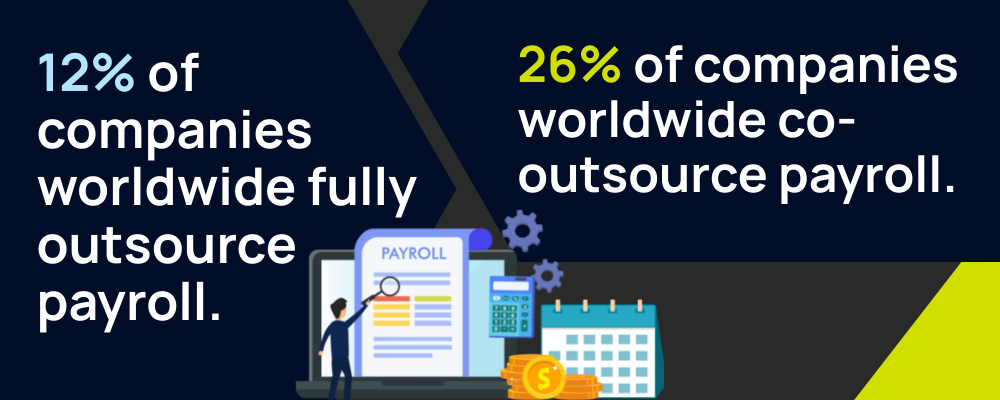
39% of US companies outsource payroll
In the United States, 39% of companies outsource payroll functions. Given the U.S. has the most complex multi-jurisdictional payroll tax environment in the world, the more relevant question may be why the other 61% haven’t made the switch. For the full trade-off framework, see our post on the advantages and disadvantages of outsourcing.
61% of European companies outsource partial or complete payroll
61% of European companies outsource partial or complete payroll, per Deloitte’s regional research. Cross-border employment across EU member states, each with distinct labor laws and payroll reporting requirements, makes in-house management difficult at scale.
Company size patterns: larger companies outsource more
Companies with more than 50 employees have a 66% chance of outsourcing payroll, compared to much lower rates among small businesses. About one-third of small businesses spend more than six hours per month on payroll processing alone, not counting tax filing or compliance audits. At $50-75 per hour for an owner’s time, that’s $300-450 monthly in opportunity cost before accounting for error risk.

Payroll Error and Employee Impact Statistics
49% of employees leave after two payroll errors
This is the statistic that gets HR directors’ attention immediately. According to UKG research, reported by HR Dive, 49% of employees will start looking for a new job after just two payroll errors. Not five. Not ten. Two. Payroll accuracy is, for most employees, the most direct signal of whether their employer is organized and trustworthy. A missed payment hits differently than a delayed email reply; the financial stakes are personal, and trust damage is fast. For retention-focused companies, payroll reliability is often the overlooked variable. See our post on HR outsourcing trends for more.
25% of employees have received paychecks with errors
One in four employees has received a paycheck with an error. Combined with the 49% departure rate after two errors, payroll errors are a systemic retention risk. The ADP Global Payroll Survey 2024 adds that 32% of payroll errors require two or more payroll cycles to fully resolve, meaning an error in January may not be corrected until March.
10-30% of US employers have misclassified at least one worker
Worker misclassification, treating an employee as an independent contractor, is one of the most expensive payroll mistakes. The US Department of Labor estimates 10-30% of US employers have misclassified at least one worker, exposing them to back taxes, penalties, and litigation.

Misclassification triggers IRS audits, state labor board investigations, and class-action exposure. Experienced payroll providers build classification review into their standard process, a risk reduction in-house teams often skip.
Payroll Outsourcing Cost Statistics
FTE ratio: 22.6 in-house vs 7.1 when outsourced
Deloitte’s payroll benchmarking data shows in-house payroll requires 22.6 employees per 1,000 workers, while outsourced payroll requires only 7.1. That’s a 68% reduction in payroll headcount for the same output. At an average US payroll specialist salary of $55,000-65,000 plus benefits, a company with 500 employees would need roughly 11 payroll staff in-house versus about 3.5 when outsourcing. This math drives most outsourcing decisions. See our post on why companies outsource.
| Metric | In-House Payroll | Outsourced Payroll |
|---|---|---|
| Payroll staff per 1,000 employees | 22.6 FTE | 7.1 FTE |
| Staff needed for 500 employees | ~11 people | ~3.5 people |
| Estimated annual payroll staff cost | $660,000+ | ~$210,000 |
| Headcount reduction by outsourcing | Baseline | 68% fewer staff |
Companies can save up to 35% by outsourcing payroll
Multiple industry analyses confirm companies outsourcing payroll can save up to 35% versus fully in-house processing. Savings come from three sources: reduced headcount (as shown by the Deloitte FTE ratio), eliminated payroll software licensing and maintenance costs, and avoided penalty expenses tied to compliance errors. Actual savings vary by company size, payroll complexity (multi-state, multi-currency, benefits administration), and provider. Smaller companies with simpler payrolls typically see 20% savings; larger companies with complex international payrolls can exceed 40%.

Outsourcing reduces payroll tax penalty likelihood by 4.3%
B2B Reviews data shows outsourcing payroll is associated with a 4.3% reduction in the likelihood of payroll tax penalties. IRS failure-to-deposit penalties range from 2% to 15% of the unpaid amount, and multi-state compliance failures compound quickly. For a company with $5 million in annual payroll, a single 5% penalty on a quarterly deposit equals $62,500. Over years, that reduction represents meaningful financial risk management.
Payroll Operational Benchmarks
99.12% on-time payroll delivery globally
The CloudPay Payroll Efficiency Index 2025 measured real-world payroll delivery performance across global operations and found an average on-time delivery rate of 99.12%. For companies that have experienced the operational chaos of a late payroll run, that benchmark represents a meaningful standard to measure providers against. When evaluating payroll outsourcing providers, on-time delivery should be a contractual commitment with a penalty clause for missed delivery windows, not a marketing claim. Ask prospective providers for their documented on-time rate over the past 12 months.
72.61% first-time approval rate across global payroll runs
CloudPay’s same index reports a 72.61% first-time approval rate for payroll runs globally, meaning about 27% of payroll submissions require at least one correction before final approval. This benchmark highlights why payroll is operationally intensive: even with experienced teams and modern software, the error and correction cycle is the norm, not the exception. Top-performing providers hit first-time approval rates above 85% through structured data validation steps before each payroll run.
63.6% of payroll errors are data-input errors
Per CloudPay, 63.6% of all payroll errors trace back to data-input mistakes, not calculation errors or system failures. The majority of payroll problems are process problems, specifically how data gets from HR systems into the payroll system. Providers that integrate directly with your HRIS solve this structurally; if a provider still uses spreadsheet uploads, that’s a red flag.
Payroll Compliance and Risk Statistics
53% of companies incurred payroll penalties in the last five years
Alight’s 2024 study found 53% of companies incurred payroll-related penalties in the last five years. More than half. The same study found 51% of companies still rely on spreadsheets for some part of their payroll process, and 19% process payroll using manual or paper-based methods. The correlation between legacy tools and compliance penalties is not accidental.
67% of companies operating across 2-5 countries received payroll fines
The same Alight study shows compliance risk compounds with geography: 67% of companies operating across 2-5 countries received payroll fines, versus 24% of single-country operations. Multi-country payroll requires up-to-date knowledge of local labor laws, tax treaties, social security regulations, and reporting deadlines in every jurisdiction, specialized knowledge in-house teams rarely sustain.
IRS failure-to-deposit penalties range from 2% to 15%
The IRS penalty schedule for failure to deposit payroll taxes scales with delay: 2% for 1-5 days late, 5% for 6-15 days late, 10% for more than 15 days late, and up to 15% if not deposited within 10 days of an IRS notice. Interest accrues on top of these penalties. A single missed deadline on a $500,000 quarterly payroll tax obligation, paid 20 days late, triggers a $50,000 penalty before interest. The annualized cost of these penalties frequently exceeds the annual cost of a quality payroll outsourcing contract. Understanding whether outsourcing is good or bad for your company often comes down to this compliance risk math.
| Days Late on Payroll Tax Deposit | IRS Penalty Rate |
|---|---|
| 1 to 5 days late | 2% |
| 6 to 15 days late | 5% |
| More than 15 days late | 10% |
| Not deposited within 10 days of IRS notice | 15% |
Payroll Technology and AI Statistics
Cloud-based payroll accounts for 80.40% of 2025 market revenue
Per Mordor Intelligence, cloud-based payroll accounts for 80.40% of total payroll outsourcing market revenue in 2025. The shift from on-premise to cloud platforms accelerated sharply after 2020, driven by remote work requirements, real-time reporting demands, and multi-location access needs. Historical context: in 2019, only 34.8% of businesses used cloud-based payroll, compared to 62% by 2022 (B2B Reviews). The migration from legacy systems over that three-year window was one of the fastest technology adoption shifts in the HR software category.

AI improves payroll calculation accuracy by up to 25%
Technavio’s market analysis found AI-powered payroll tools improve calculation accuracy by up to 25% versus traditional rule-based processing. AI handles variable pay components, overtime, multi-state tax computations, and benefit deductions more consistently at scale. The practical implication: AI is making payroll specialists more accurate, not replacing them, consistent with trends in call center statistics and other outsourcing domains.
Robotic process automation reduces manual data entry errors by 30%
Technavio also reports robotic process automation (RPA) reduces manual data entry errors in payroll by 30%. Given 63.6% of payroll errors start with data input, RPA addresses the root cause directly. Automated data extraction from timesheets, expense reports, and HRIS systems eliminates the transcription errors human data entry introduces. Technavio adds that cloud-based payroll platforms reduce overall processing time by approximately 35% versus legacy systems, through automation of routine tasks like tax table updates, direct deposit processing, and regulatory report generation.
40% of payroll teams still use spreadsheets as a primary tool
Despite the technology gains, EY’s Global Payroll survey (via the EY-GPMI) found 40% of payroll teams still use spreadsheets as a primary tool. The same EY data shows 75% of payroll professionals prioritize accuracy as their top concern and 60% plan to budget for more advanced payroll technology in the next 12 months. The gap between priorities and tools is exactly where outsourcing providers fill a need: they bring the technology investment as part of the service.
Payroll Outsourcing Industry Trends for 2026
AI and automation reshape payroll work
The 25% accuracy improvement and 30% error reduction from AI and RPA (per Technavio) are shifting payroll teams from data processing toward exception management and strategic analysis. The best outsourcing providers in 2026 are not just processing payroll accurately; they’re delivering reporting and analytics that drive better workforce decisions. See our post on the future of outsourcing for the broader technology trajectory.
Skills shortage drives outsourcing demand
The ADP Global Payroll Survey 2024 found 83% of payroll teams are expanding their workforce, yet 61% report significant skills shortages. Companies unable to hire qualified payroll staff are turning to outsourcing as a direct talent-access solution, a structural shift from cost-cutting as the primary motivation. See our post on commonly outsourced jobs for more.
Compliance prioritization intensifies
With 53% of companies having incurred penalties in the last five years and global tax regulations continuing to change, compliance has moved from a background concern to a board-level priority in 2026. The ADP survey found 38% of payroll teams now name data security and compliance as their top investment priority. Payroll outsourcing providers that maintain dedicated compliance teams and real-time regulatory monitoring are well-positioned to capture this demand.
What 15+ Years in Philippine BPO Tells Us About Payroll Outsourcing Demand
At Digital Minds BPO, payroll and bookkeeping inquiries follow a predictable pattern: companies come to us after a compliance penalty or after losing a payroll specialist to turnover. Very few come proactively. The ones who do tend to be scaling internationally and recognize early that multi-country payroll is not something a small in-house team can manage reliably. The data in this post reflects what we see in practice: the cost is real, the compliance risk is real, and the skills shortage is real.
Methodology
Statistics sourced from primary research reports, government data, and industry surveys published 2023-2025. Primary sources: Mordor Intelligence, Technavio, IMARC Group, Deloitte, Alight (2024), ADP (2024), CloudPay (2025), EY-GPMI, UKG (via HR Dive), B2B Reviews, the US Department of Labor, and the IRS. Historical B2B Reviews data from 2019 and 2022 is labeled as historical context. Statistics last reviewed in April 2026.
Frequently Asked Questions About Payroll Outsourcing
What percentage of companies outsource payroll?
Per Deloitte’s payroll operations survey, 73% of organizations outsource at least one payroll activity. In the US, 39% of companies outsource payroll functions; in Europe, the rate is 61%. Adoption is significantly higher among companies with over 50 employees compared to small businesses.
How much does it cost to outsource payroll?
Most providers charge a per-employee, per-month fee ranging from $20-$150 depending on scope, plus a base platform fee. Deloitte’s benchmarking shows outsourcing cuts the payroll FTE ratio from 22.6 to 7.1 per 1,000 employees. Industry analyses show total savings of up to 35% versus fully in-house operations. See the 2026 outsourcing statistics for broader cost benchmarks.
How does outsourcing reduce payroll errors?
Three mechanisms: dedicated teams with deeper specialization than in-house staff; automated data integrations that eliminate manual data entry (the source of 63.6% of errors per CloudPay); and AI tools that improve calculation accuracy by up to 25% while RPA cuts manual input errors by 30% (Technavio). The best providers hit first-time approval rates above 85%.
What are the biggest payroll outsourcing trends for 2026?
Three major trends: AI and RPA integration (improving accuracy by 25% and cutting data-entry errors by 30% per Technavio); outsourcing as a response to skills shortages (61% of teams report difficulty hiring qualified payroll staff, per ADP); and intensified compliance investment (38% of teams name data security and compliance as their top budget priority). See the future of outsourcing for more.
Is payroll outsourcing worth it for small businesses?
For most small businesses with more than 10 employees, yes. The time cost alone (six-plus hours monthly for one-third of small businesses) is $300-500 monthly in owner time. Add compliance risk (53% of companies have incurred penalties in five years) and retention risk (49% of employees leave after two payroll errors), and the case is straightforward. The exception: companies with very simple payrolls (fewer than five employees, salaried only, single state), where modern software may suffice. See advantages and disadvantages of outsourcing.
Conclusion
These 40+ payroll outsourcing statistics point to the same conclusion from multiple directions: the cost of managing payroll in-house, in time, compliance risk, and retention exposure, consistently exceeds what most companies realize. The market is growing at 6.19% annually because more companies are running the numbers and making the switch. Digital Minds BPO provides payroll processing and bookkeeping to clients across the US, Australia, and the UK from Naga City, Philippines, with a 94% client retention rate and 15+ years of experience. If you’d like to understand what an outsourced setup would look like for your headcount and complexity, book a free consultation below.

Charvel Rebagay is the CEO and Founder of Digital Minds BPO, a Philippines-based outsourcing company he established in 2010. Based in Naga City, he works directly with clients and teams daily to ensure service quality across every engagement. With over 15 years of experience building and managing dedicated teams for businesses worldwide, Charvel has helped hundreds of companies scale their operations through skilled Filipino professionals. Under his leadership, Digital Minds BPO operates 3 dedicated facilities with a 94% client retention rate, serving Fortune 500 clients including P&G and Petron.