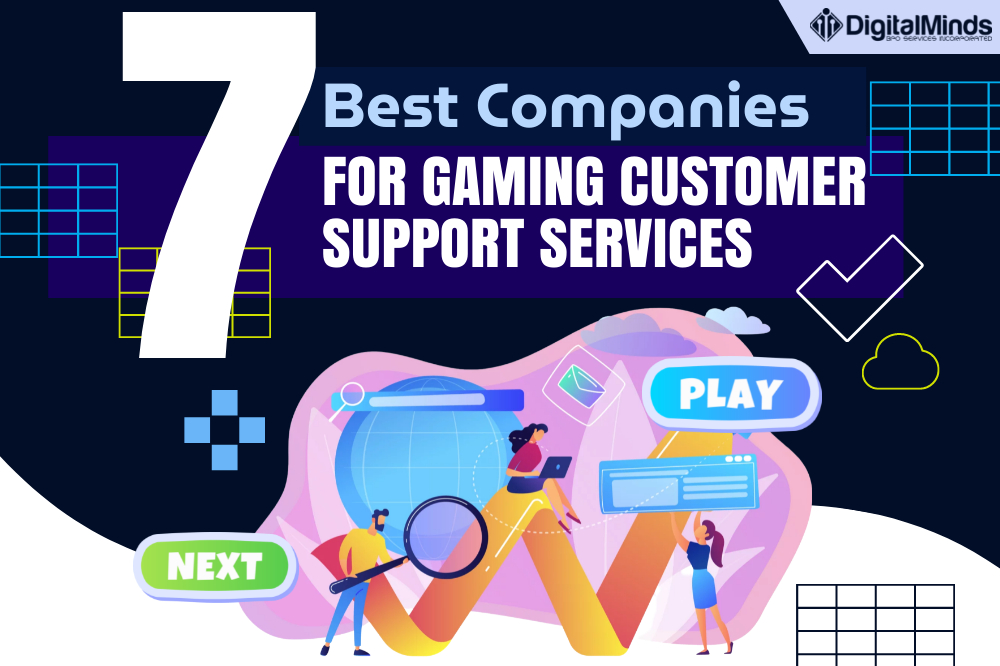
The best gaming BPO companies give studios a dedicated support team that already understands how players talk, pay, and complain. This list covers seven gaming customer support companies worth shortlisting for 2027, from a dedicated-team specialist in the Philippines to large global game-services groups. Each entry says what the company offers, based on its own website, and who it suits best.
Digital Minds BPO, a business process outsourcing company based in Naga City, Philippines, wrote this list and puts itself first. That is a bias you should weigh, so every entry closes with a plain “Best for” line, including the companies that suit larger studios better than we do. If you are comparing gaming BPO options for a launch, a live game, or a mobile title after release, the table below is the quickest way to narrow the field.
Updated for 2027.
Which Gaming BPO Companies Should You Shortlist in 2027?
The seven gaming BPO companies worth shortlisting in 2027 are Digital Minds BPO, Keywords Studios, TELUS Digital, ModSquad, Peak Support, Conectys, and TaskUs. They differ most on team model: some sell a dedicated managed team, others sell player support as one service inside a wider game-services group. Match the table to your studio’s size and the problem you are solving, then read the entries for detail.
| Company | Gaming services (from its own site) | Coverage | Best for |
|---|---|---|---|
| Digital Minds BPO | 24/7 player support by chat, email, and phone; gaming content moderation; community moderation | Naga City, Philippines; English-speaking agents, with chat and email in other languages via translation tools | Small to mid-sized studios and live games that want a dedicated, managed team |
| Keywords Studios | Player engagement and the Helpshift support platform, within a wider game-services group | Clients and audiences “around the world”; locations not stated for this service | Publishers that already buy other game services from one group |
| TELUS Digital | Multi-channel player support, fraud prevention, player community protection | Teams in 35+ countries; multilingual, languages not named | Larger publishers that need support, fraud prevention, and moderation across regions |
| ModSquad | Player support, content moderation, community management, play testing, live ops | 24/7 multilingual coverage in 55+ languages | Community-heavy games with live ops or launch surges |
| Peak Support | Player support and trust and safety for gaming and esports companies | Confirm locations and languages with the provider | Studios that want support and trust and safety from one specialist |
| Conectys | Customer support and trust and safety; gaming listed among industries served | 70+ languages and 15+ locations, per its site | Studios that need many languages plus moderation |
| TaskUs | Trust and safety and moderation for virtual communities; customer experience listed as a related service | Sites in 13 countries; moderation case study in 30+ languages | Publishers with heavy user-generated content and moderation volume |
Services and coverage come from each company’s own website. Where a site did not state coverage, the table says so rather than guessing.
The 7 Best Gaming Customer Support Companies for 2027
These seven are ordered by fit for studios buying a dedicated, managed support team, not by company size. A large global group is not automatically the right fit for a 12-person studio, and a small provider is not the right fit for a publisher that needs a dozen languages on launch day. Read the “Best for” line first, then the detail.
1. Digital Minds BPO
Digital Minds BPO has built dedicated support teams from Naga City, Philippines, since 2010. Its gaming work covers 24/7 player support by chat, email, and phone, plus moderation of in-game content and player communities. Client names stay confidential, so no titles are listed here, but both services run around the clock for gaming clients today.
Every team is full-time and dedicated, led by a Team Leader, and learns your game’s tools and playbooks rather than rotating through a shared pool. Agents are English-speaking. Chat and email can reach players in other languages with translation tools, while voice is English only, so a title with a large non-English voice queue needs a different plan. Studios that want live chat support answered by the same agents every day get that structure by default.
The proof points are specific: 94% client retention, a 4.7-year average partnership, up to 70% cost savings, 3 dedicated facilities in Naga City, and clients that include Fortune 500 names such as P&G and Petron. Pricing is published (see the FAQ below), which most providers on this list do not.
The coverage math is straightforward. Teams start at 3 dedicated agents for studios with lighter hours, and true 24/7 coverage needs at least 5 agents per queue. Onboarding takes 2 to 4 weeks for a team of 5, counted from the signed agreement and deposit, so the team can be learning your game before launch day instead of during it.
For the full service model, the gaming customer support outsourcing page explains how a team is built and staffed, and the gaming content moderation services page covers the safety side.
Best for: small to mid-sized studios and live games that want a dedicated, managed team at published rates.
2. Keywords Studios
Keywords Studios sells player support as one service inside a large game-services group. Its Engage division lists Player Engagement and Helpshift, a support platform, among its offers. A Helpshift case study on its site cites a “record-breaking lift in CSAT” for Gameloft. Because Helpshift is a platform and Player Engagement is a service, ask whether a quote covers software, agents, or both.

The site does not tie player support to specific languages or delivery locations, so ask where your queue would be staffed. The draw is one contract across several game services. The question worth asking is how much attention a single support queue gets inside a group of that breadth.
A fair test is to ask who your day-to-day contact would be, whether the agents on your queue work only on your game, and how quickly a team can be added if a launch outperforms the forecast.
Best for: publishers that already buy other game services and want player support under the same group.
3. TELUS Digital
TELUS Digital, formerly TELUS International and renamed in 2024, frames its games offer around the post-launch lifecycle. Its games page names multi-channel player support across email, chat, social, and voice, covering gameplay, technical, and payment issues. It also lists fraud detection and prevention, and player community protection that pairs AI with human oversight.
AI-powered customer service tools for self-service, agent assistance, and proactive issue detection sit on the same page, which says player demand “doesn’t follow regular office hours or come from a single region.” On coverage, it cites teams in 35+ countries that can deliver through shared workday windows. Support is described as multilingual without naming languages, so request the language list for your specific queue before you rely on it.
With that many delivery countries, the practical questions are which site would staff your queue and whether the team that handles your launch is the team that stays on afterward. Get both answers in writing.
Best for: larger publishers that need multi-channel support, fraud prevention, and moderation from one provider across regions.
4. ModSquad
ModSquad describes its gaming work as “player support, content moderation, community management, and play testing,” with Trust and Safety and Live Ops alongside. Its gaming page says it covers “live ops, launch surges, toxic behavior, and multilingual communities across PC, console, and mobile,” with 24/7 multilingual coverage in 55+ languages.
The company cites nearly two decades in gaming and clients from indie studios to AAA publishers. The page says this work is “staffed by gamers,” and play testing sits on the same list, so ask whether agents who support players also feed bug patterns back to your QA team. Because these are the provider’s own claims, request the staffing plan behind a launch surge and the list of languages covered by native speakers.
Live ops and launch surges are the two moments when a studio learns whether a provider’s coverage claim holds. Ask for a reference from a studio of your size and genre, and ask what happened to ticket response times the last time a client’s launch ran ahead of plan.
Best for: studios running live ops or community-heavy games that need moderation and support together, in many languages.
5. Peak Support
Peak Support serves gaming and esports companies with customer service and a trust and safety practice that covers content moderation and fraud detection. Those are the service areas its gaming page lays out, and it is a focused offer: support and safety from a specialist rather than a broad game-services group.
Public detail on the gaming offer stops at those service areas, so ask for delivery locations, languages, and ramp time for your queue before shortlisting. A focused specialist can mean fewer layers between you and the team; the matching question is what happens to your staffing if player volume doubles after a successful launch.
Fraud work deserves its own question. Moderating a chat channel and investigating abnormal purchase patterns need different skills, so ask whether the same agents cover both or whether separate teams do, and how each is trained on your game’s economy.
Best for: studios that want player support and trust and safety, including fraud work, from one specialist provider.
6. Conectys
Conectys lists gaming among the industries it serves and pairs customer support with full-spectrum trust and safety, including content moderation it describes as “AI-powered, human-verified.” Its site cites 70+ languages supported and delivery from 15+ locations across EMEA, North America, Latin America, and Asia-Pacific.
Its EMEA sites include Poland, Romania, Portugal, Turkey, Greece, and Egypt, which helps if you want European time-zone overlap. Its site does not detail a gaming-specific player support offer, so the useful question is how its multilingual desk is staffed for game queues: ticket types, escalation paths, and hours. For studios whose main constraint is language range, it belongs on the shortlist.
A headline language count is not a staffing plan. Ask for the exact list of languages that would sit on your queue, with the native-speaker share for each.
Best for: studios whose main need is wide language coverage combined with moderation.
7. TaskUs
TaskUs leads its gaming page with moderation and safety rather than player support. The headline is “Keeping virtual communities safe,” and the page describes “specialized, culturally aware moderation” for immersive spaces, with Trust & Safety, Wellness & Resiliency, AI Safety & Alignment, and Customer Experience listed as related services.
The page cites a case study titled “Moderating UGC in 30+ languages,” says Everest Group named TaskUs a Leader in its Trust and Safety Services PEAK Matrix Assessment for the third consecutive year, and lists delivery sites in 13 countries, including Mexico, Colombia, Ireland, India, and the Philippines. It does not describe a player support offer by name, so ask directly what a ticket-handling team for your game would look like and which site would staff it.
Best for: publishers with heavy user-generated content that need trust and safety and multilingual moderation at scale, with player support scoped as a separate conversation.
Why Studios Are Outsourcing Gamer Support
The ESA 2026 Essential Facts report counts 212.3 million Americans who play video games, and US consumer spending on video games reached $60.7 billion in 2025. Every one of those players can open a ticket about a purchase, a bug, or a ban.
The teams answering them are smaller than they were. The GDC 2026 State of the Game Industry survey found that 28% of its 2,300+ respondents were laid off in the past two years, rising to 33% in the US. Leaner studios still have to answer every ticket, and a dedicated external team adds capacity without a hiring round.
Retention raises the stakes on mobile. GameAnalytics’ 2026 Mobile & PC Gaming Benchmarks put median mobile day-1 retention around 22% in 2025, and these mobile game retention benchmarks show how few players a typical game keeps beyond the first days. An unanswered payment or login ticket in week one can cost you a player you paid to acquire.
For the daily work an external team takes on, see how player support teams handle refunds, bans and bug reports.
How to Choose a Player Support Partner
Eight criteria separate a partner that knows games from a generic contact center. Put the same questions to every company on this list, Digital Minds BPO included, and compare the answers side by side.
| Criterion | What to ask | Why it matters |
|---|---|---|
| Game fluency | Which genres have your agents supported, and can they play your build? | Agents who know the game recognize a real bug and route a balance complaint correctly. |
| Launch and surge readiness | How fast does a full-time team ramp, and will it be in place before launch? | A ramp takes weeks, so a team ordered during a spike arrives too late for it. |
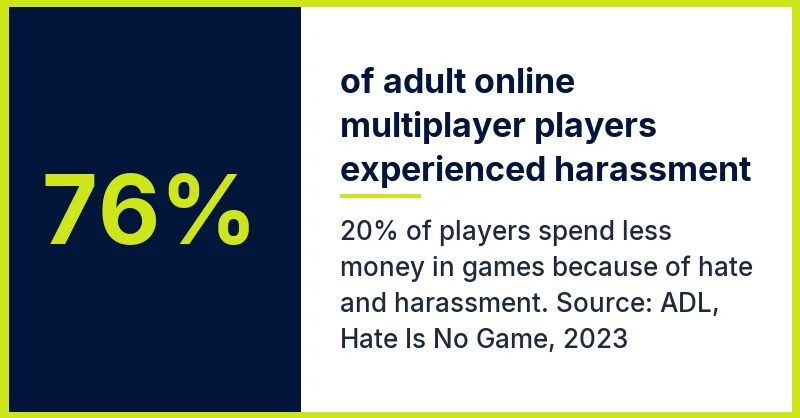
| Trust, safety, and minors | Who handles community moderation, and how are reports involving minors escalated? | The ADL “Hate Is No Game” 2023 report found 76% of adult online multiplayer players experienced harassment, and 20% of players (adults and teens) spend less money because of hate and harassment. |
| Payments, refunds, and account recovery | Who can approve refunds, and what record is kept of each decision? | The FTC ordered Epic Games to pay $245 million in refunds over in-game purchases, part of $520 million in total relief. |
| Channels and hours | Do you cover in-app customer support, chat, and email, and does your gaming call center take voice? Is coverage truly 24/7? | Players are online in every time zone, and each channel needs its own staffing. |
| Languages | Which languages are native, and which are translation-assisted? | Translation tools handle routine tickets well; bans and payment disputes need an agent fluent in the player’s language. |
| Player data and tools | Which helpdesk and admin tools will agents use, and how is player data handled? | Agents need account and purchase context to resolve a ticket in one touch. |
| Pricing model | Is it estimated monthly per dedicated agent, billed hourly on actual hours, or per ticket? | Per-ticket cost rises with volume during a spike; a dedicated team prices the capacity instead. Numbers are in the FAQ. |
What Supporting Live Games Around the Clock Has Taught Us
Soon after a new gaming client’s dedicated team went live with us, the client hit an issue at launch and support requests poured in around the clock. Because the 24/7 team was already onboarded, it absorbed the surge. The client’s own staff could not have answered every ticket alone.
The timing was luck, because nobody had planned the team around that issue. A launch plan should not depend on luck. A small full-time team takes 2 to 4 weeks to ramp, a bigger one takes longer, and you cannot hire for a spike after it starts. Put the team in place before launch, while its only job is learning your game.
It also changes what you ask a provider. “How many agents can you add?” matters less than “How many weeks before they can answer a ticket about my game?” Ask for that number in writing, and plan your launch date around it.
Ready to Build a Player Support Team That Knows Your Game?
Digital Minds BPO builds dedicated, full-time player support teams, led by a Team Leader and set up to be in place before your launch date. Book a free consultation and we will walk through your queue, your hours, and your launch timeline, then price the team on published rates. Your agents stay on your account and are never moved between clients, so the people who learn your game are the people who answer your players.
Frequently Asked Questions About Gaming Customer Support Companies
How much does it cost to outsource gaming customer support?
Digital Minds BPO prices each dedicated agent as Est. Monthly, Billed Hourly, so you pay for actual hours worked, not a flat fee. Chat and email player support runs $924 (Entry), $1,260 (Mid), and $1,596 (Expert) est. monthly, billed at $5.50, $7.50, and $9.50 per hour. Voice player support and gaming content moderation run $1,092, $1,428, and $1,764 est. monthly, billed at $6.50, $8.50, and $10.50 per hour. Compare any per-ticket quote against these on the same ticket volume. Team Leader and Project Manager support comes with the team and is not a separate line item.
When should a studio outsource player support instead of hiring in-house?
Outsource when ticket volume outgrows the people you can spare from development, when players in several time zones need round-the-clock answers, or when a launch is close and hiring would finish after it. In-house still makes sense when support needs constant access to unreleased builds or the queue is tiny and stable. Many studios split the work: a small in-house lead sets policy, and a dedicated external team runs the queue. A practical signal is a backlog that reappears after every patch or event, because that means the queue has outgrown spare capacity.
Can an indie or small studio outsource player support?
Yes, with a limit. Digital Minds BPO teams start at 3 dedicated agents, and true 24/7 coverage needs at least 5 agents per queue. A studio handling a handful of tickets a day will usually do better with founder-led support until volume justifies a team. Once players are active in several time zones, a small dedicated team costs less than the missed tickets. Starting at 3 agents also covers breaks, leave, and sick days without a gap in the queue.
How quickly can an outsourced team be ready for a game launch?
Digital Minds BPO staffs full-time teams only, with no launch-only or seasonal seats. Onboarding takes 2 to 4 weeks for a team of 5, counted from the signed agreement and deposit, and longer for a bigger team. Set the team up before launch so agents learn the game, the tools, and your refund rules while the queue is still quiet. Share your patch calendar and expected launch-day volume on the first call so the team size is set against real dates.
Can one partner handle player support and content moderation?
Yes. Digital Minds BPO runs 24/7 player support and moderation for gaming clients, and the content moderation services page covers the moderation side in detail. One partner means support agents and moderators work from the same escalation notes, which helps with ban appeals and repeat offenders. Agree up front on when a support ticket becomes a moderation case, and when it goes back. Other providers on this list, including ModSquad and TELUS Digital, also pair the two.
What languages can an outsourced player support team cover?
Digital Minds BPO agents are English-speaking. Chat and email can reach players in other languages with translation tools, and voice is English only. Studios that need native multilingual voice should look at providers such as ModSquad or Conectys, which cite 55+ and 70+ languages respectively on their own sites. Ask any provider which languages are native and which are translation-assisted. If a language matters for refunds or bans, request a sample reply in that language before you sign.