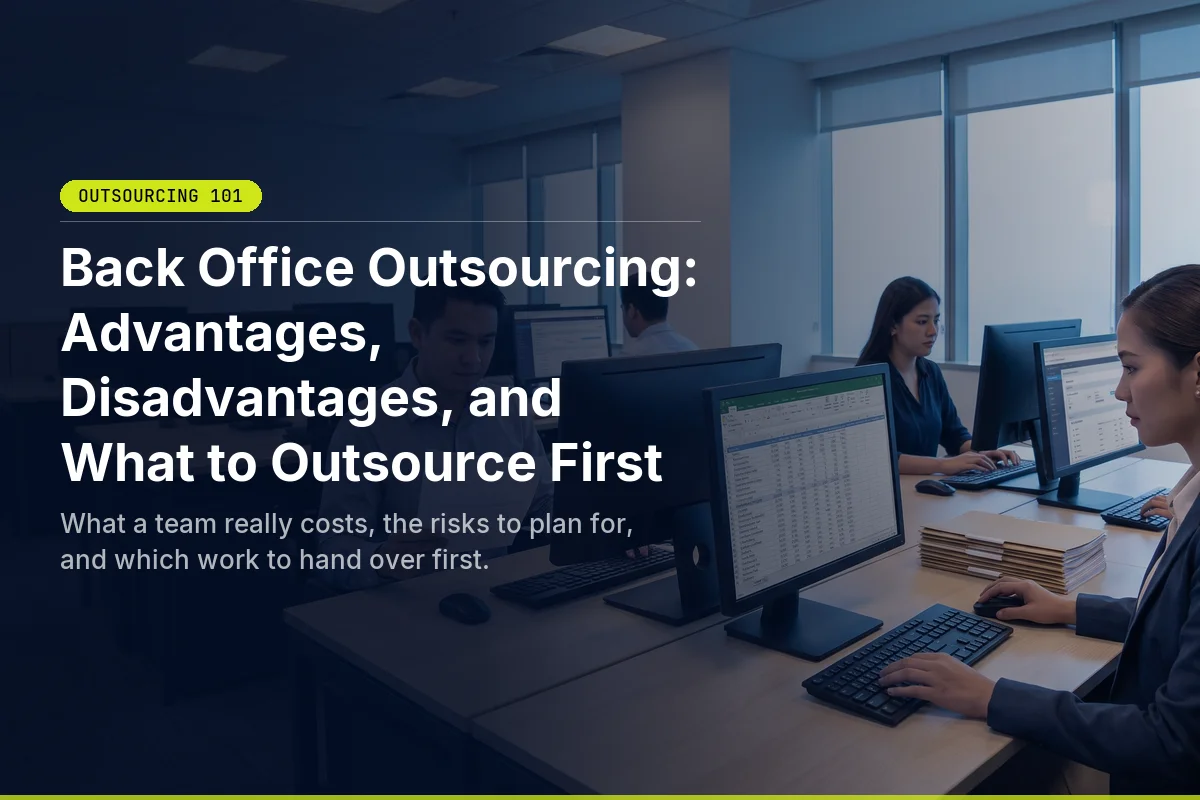
Back office outsourcing hands the work your customers never see (billing, bookkeeping, claims, data entry, admin) to a dedicated outside team, so your own people can focus on growth. Done well, it cuts overhead and clears backlogs. Done badly, it adds risk and rework.
This guide covers the pros and cons, what a team costs, and a simple test for what to hand over first. Digital Minds BPO, a business process outsourcing company in Naga City, Philippines, has built back office teams since 2010, so the advice comes from running them.
What Is Back Office Outsourcing?
Back office outsourcing is the practice of moving internal support work, the tasks that keep a business running but involve no direct customer contact, to a specialist team outside your company. You may also see it called back office business process outsourcing, back office process outsourcing, or back office BPO. Whether it is spelled back-office outsourcing or backoffice outsourcing, the idea is the same: the outside team follows your process and reports against agreed targets, and you keep the decisions.

The front office is where customers meet you: sales, support, and reception. The back office is everything behind it: finance, admin, compliance, and data. For more detail, see the difference between the front office and back office, and read what outsourcing means if the term is new to you. Our back office support services page shows how Digital Minds BPO structures these teams.
Grand View Research values the global BPO market at USD 328.4 billion in 2025, growing to USD 695.8 billion by 2033 (a 9.9% CAGR). That figure covers all outsourced business processes, not the back office alone.
Which Back Office Functions Can You Outsource?
Outsourcing back office functions works best on repeatable work with clear inputs and outputs. The table lists the back office outsourcing services Digital Minds BPO teams handle, starting with healthcare, where the work leans on human judgment: payer calls, follow-up, and billing exceptions.
| Function | Typical tasks | Good fit when |
|---|---|---|
| Medical billing | Claims, denials, prior-authorization follow-up | Claims backlog is growing |
| Insurance claims processing | Intake, document checks, status updates | Volume swings month to month |
| Finance and accounting: outsourced bookkeeping, accounts payable outsourcing, outsourced accounting | Bookkeeping, invoice matching, reconciliations | Month-end close runs late |
| Administrative services outsourcing | Scheduling, document handling, inbox management | Managers spend hours on admin |
| Data entry | Records, forms, database updates | Accuracy matters more than speed |
| Order processing | Order entry, status checks, returns paperwork | Sales growth strains fulfillment |
| Content moderation | Reviewing posts and listings against your rules | User content outpaces your reviewers |
| Image annotation | Labeling images for training datasets | You need volume without hiring |
Automation fits here too. Rules-based steps, like matching an invoice to a purchase order, can run automatically. People handle the exceptions and judgment calls, and that is where a dedicated team earns its place.
Back Office Outsourcing Advantages
Back-office outsourcing helps you save time and money, and it can make your office run more smoothly. The advantages depend heavily on the partner you hire.
Reduce Your Overhead Costs
Saving money is the best-known reason for outsourcing. Digital Minds BPO clients save up to 70% on staffing costs. Lower overhead can make your small business more profitable without cuts to the rest of your operations.
Direct labor is one place you save. You also spend less on hiring and training. Add employee turnover, office space, and new equipment, and the gap against hiring in-house widens.
Gain Access to Experienced Talent
Lower labor costs do not mean less experience. Business process outsourcing (BPO) companies build teams with the skills you need. Deloitte’s Global Outsourcing Survey 2024 found that skilled talent and agility now join cost as reasons to outsource.
Hiring and onboarding get easier too. Your partner recruits, screens, and runs the first 5 days of training, so you skip most of the work of getting new hires up to speed.
Improve Efficiency and Reduce Errors
Saving time and resources lets your staff handle their responsibilities with greater ease, and your office may become more efficient. That efficiency can mean fewer errors, because people who do not feel rushed can concentrate on the task at hand.
Better Morale and Customer Service
A more efficient back office can lead to unexpected wins, like better morale and customer service. Taking routine work off your staff means less stress over tight deadlines and more freedom to focus on your core competency. Happy, focused employees address your customers’ needs better.
Receive Scalable Solutions
Back office outsourcing is also scalable. Keeping an efficient back office gets harder as your business grows, because you must hire more staff and manage more processes. Outsourcing turns a new hire into a request to your partner instead of a job ad, a desk, and a laptop. It also costs less than hiring more staff in-house.
Disadvantages of Back Office Outsourcing
The disadvantages of BPO are real, and most come down to distance, control, and data. The advantages and disadvantages of outsourcing in general apply here too, and each risk below ends with a way to reduce it.

Cultural Barriers
Businesses in the United States, Canada, the UK, Australia, and parts of Europe often outsource to companies in the Philippines. Still, working with people in another country can create cultural barriers. The team handling your back office tasks may not fully grasp certain phrases, slang, or cultural norms.

How to reduce it: choose a partner whose staff work in English daily, and write instructions as plain steps instead of idioms.
Shifting Timeframes
Time zones can add a second barrier. If your provider is in a country with a major time-zone difference, you may struggle to keep communication flowing. Different holidays mean different days off, and the time gap and the holidays can both interrupt your daily operations.
How to reduce it: agree overlap hours and a shared holiday calendar before kickoff. Digital Minds BPO teams work to the client’s schedule.
Quality Control
You have less direct control over a dedicated team’s day-to-day work, and you cannot oversee it the way you oversee people down the hall. Without that control, the risk of lower-quality output, delays, and other problems goes up. In regulated work such as medical billing or claims, one error can mean a denied claim or a compliance finding, not only rework.
How to reduce it: put accuracy and turnaround targets in writing, and sample the work every week. At Digital Minds BPO, the shared Team Leader runs quality checks at no extra cost.
Information Security Challenges
Outsourcing your back office means external workers may access sensitive information, and you have less control over your provider’s security protocols. The Verizon 2025 Data Breach Investigations Report found that third-party involvement in breaches doubled to 30%. The IBM Cost of a Data Breach Report 2026 puts the global average breach at USD 4.99 million, up 12%.
Depending on your industry and region, you may also need to follow specific data protection regulations, such as HIPAA or GDPR. Your business pays when information leaks or rules are broken: you may lose customers and face penalties. How to reduce it: ask for security controls in writing, using the partner checklist below.
Lack of Coordination with In-House Staff
Managers often find it hard to coordinate between departments in a single office. Coordinating with a team in another country adds more problems, because information can get lost in translation or arrive late. Many operations involve multiple steps, so your in-house staff may occasionally wait for the dedicated team to finish a task.
How to reduce it: name one point of contact on each side and hold a short weekly review.
How Much Does Back Office Outsourcing Cost?
A Digital Minds BPO back office team member costs $6.50, $8.50, or $10.50 an hour (Entry, Mid, Expert), an estimated $1,092, $1,428, or $1,764 a month full-time (Est. Monthly · Billed Hourly). We bill the hourly rate on actual hours worked. Here is how that compares with an in-house hire.
| Cost line | In-house hire | Outsourced dedicated team |
|---|---|---|
| Pay | Salary, benefits, payroll taxes | $6.50 / $8.50 / $10.50 an hour, billed on actual hours |
| Recruiting | Job ads, interviews, agency fees, repeated after each resignation | No recruitment fees |
| Setup | Equipment, software seats, office space | No setup fees; hardware and IT support included |
| Training | Your manager’s time | First 5 days of training included |
| Management | Your own manager or supervisor | Shared Team Leader (1:20 on non-voice teams) and Project Manager included |
The Team Leader and Project Manager are included in the hourly rate, and the first 5 days of training are free, so there is no separate management fee. These rates cover general back office support; finance and accounting, medical billing, content moderation, data entry, order processing, and image annotation are quoted on their own rate cards.
Savings are real but not automatic. The Deloitte 2025 Global Business Services Survey found that about half of organizations achieved savings above 20% from their global business services operations, which combine shared services and outsourcing. Scope and management, more than the rate, decide the result. For small business back office outsourcing, teams start at 3: three Entry team members come to an estimated $3,276 a month.
Before you sign, compare outsourcing pricing models and read about the hidden costs of outsourcing.
What to Outsource First, and What to Keep In-House
Fix the process before you hand it over. An outside team will repeat a messy process faster; it will not repair it. Once the steps are written down, sort your work into three groups.
| Group | Examples | Why, and the risk |
|---|---|---|
| Outsource first | Data entry, order processing, document indexing, scheduling | High volume, clear rules, measured by accuracy and turnaround. One bad item rarely does lasting harm. |
| Outsource with controls | Medical billing and claims follow-up, accounts payable, reconciliations, customer-data handling | Regulated or money-moving work. Needs approval limits, sampling, and access rules; an error can reach a patient, vendor, or regulator. |
| Keep in-house | Pricing and strategy, final payment approval, hiring decisions, vendor negotiation, sensitive legal matters | Judgment and accountability belong with owners. Hand these over and nobody on your side owns the outcome. |

Deloitte’s Global Outsourcing Survey 2024 shows how normal this sorting is: 70% of executives have selectively taken scope back from third parties over five years, yet 80% plan to maintain or increase outsourcing investment. Taking a task back is part of running a mature outsourcing model.
If you run a small business, start with one function from the first row and run it for a quarter before adding another. For a closer look at the trade-off, read insourcing vs outsourcing and the common outsourcing challenges.
How to Choose a Back Office Outsourcing Partner and Run the Handover
Judge a partner on evidence you can check, then start with a pilot that has written exit criteria. This checklist shows what good looks like and what should worry you.
| Check | What good looks like | Red flag |
|---|---|---|
| Security | Office-based work only, NDAs, no personal phones or USB devices on the production floor (company-issued phones only where a program needs them), HIPAA training for healthcare teams, GDPR compliance, a certified Data Protection Officer | Reassurance with no written controls |
| Proof of fit | References in your function and industry | Only generic case studies |
| Pricing | Itemized rate, billed on actual hours | Setup or recruitment fees appear later |
| Team structure | A named Team Leader and Project Manager | You end up managing every person |
| Pilot | Written scope, start date, and exit criteria | Long lock-in before you see output |
| KPIs and SLA | Accuracy, turnaround, and backlog agreed before day one | No metric until something breaks |
Digital Minds BPO does not hold SOC 2 today, so ask any partner, us included, to show its controls in writing.
Run the handover in order. Document the process, pilot one function, then review accuracy, turnaround, and backlog weekly against your SLA and monthly once results hold. Exit criteria state in advance what ends the pilot: expand the team, adjust the scope, or stop. A Digital Minds BPO pilot runs 3 months, and you can leave on 30 days’ written notice with no exit fee. If you are building a shortlist, our roundup of back office outsourcing companies is a starting point, and these questions to ask before you outsource will sharpen your pilot brief.
Lessons From 15 Years of Running Back Office Teams
Over 15 years of running back office teams have settled three rules at Digital Minds BPO:
- Teams start at 3 people, so one sick day or resignation does not stop your back office. A Team Leader and Project Manager come included.
- Training comes with the team: the first 5 days are included.
- Billing follows actual hours worked, so you pay for work done.
The results show in 94% client retention and an average partnership of 4.7 years. Jake Williams, President of Make A Fort LLC, describes how one relationship grew: “What started as customer service grew into dedicated support across marketing, supply chain, accounting, and bookkeeping.” His advice is to “start small where you have the greatest need, then expand as you see what’s possible.”
Conclusion: Is Back Office Outsourcing Right for You?

For most growing businesses, the advantages outweigh the disadvantages when the work is repeatable and the controls are written down. Each drawback above has a practical fix: overlap hours, accuracy targets, security controls in writing, and one point of contact on each side.
Our services eliminate many of the potential concerns of back office outsourcing. We provide back office outsourcing in the Philippines, a country that shares many cultural traits with the US and English-speaking countries. Since 2010, we have built teams for growing companies and for Fortune 500 clients, including P&G and Petron.
You are ready when a repeatable task eats hours your team should spend on growth, the process is written down, and someone on your side can own the weekly review.
Ready to Grow Your Business?
Find out how much our outsourcing services cost. It usually takes 1 to 2 days to receive your proposal. Recruitment for your team starts as soon as your deposit clears.
Frequently Asked Questions About Back Office Outsourcing
What is an example of back office outsourcing?
A medical practice hands claims follow-up and prior-authorization calls to a dedicated team. The team tracks each claim, chases payers, and flags denials to the practice’s billing manager, who makes the final decisions. Bookkeeping, accounts payable, and data entry follow the same pattern.
What is the back office in BPO?
In BPO, the back office means internal support processes with no direct customer contact: finance, administration, data handling, claims, and order processing. Back office BPO moves those processes to a specialist provider, while front office BPO covers customer-facing work such as support and sales.
What is the difference between front office and back office outsourcing?
Front office outsourcing covers work customers see: support, sales, and reception. Back office outsourcing covers the work behind it: billing, claims, bookkeeping, data, and admin. Front office roles lean on communication and tone; back office roles lean on accuracy and process discipline. Many businesses outsource both, in separate teams.
Is outsourcing a dying concept?
No. Deloitte’s Global Outsourcing Survey 2024 found that 80% of executives plan to maintain or increase outsourcing investment, while 70% have selectively taken some scope back. That points to a maturing model: businesses now choose more carefully what to outsource and what to keep.
How long does it take to transition back office work?
Digital Minds BPO onboards 1 to 5 people within about 2 weeks. Larger teams take about 4 weeks for training and integration. Exact timing depends on role complexity, so document your process before kickoff.
Is back office outsourcing worth it for a small business?
Small business back office outsourcing works when the tasks are repeatable and eat owner or manager time. Teams start at 3, and three Entry team members cost an estimated $3,276 a month, billed on actual hours. Start with one function, measure accuracy and turnaround for a quarter, then decide whether to expand.
How do I check a provider’s security and compliance?
Ask for controls in writing: NDAs, device and phone rules, data-protection training, and a named compliance owner. Digital Minds BPO works from its Naga City offices only, requires NDAs, keeps personal phones and USB devices off the production floor, trains healthcare teams on HIPAA, complies with GDPR, and has a certified Data Protection Officer. It does not hold SOC 2 today.

Sofia Reyes is a Content Writer and SEO Specialist at Digital Minds BPO, where she focuses on outsourcing-industry research and educational content for business decision-makers. Based in the Philippines, she has 7 years of experience writing B2B content across SEO, content strategy, and Generative Engine Optimization (GEO). Sofia partners with Digital Minds BPO’s operations and account management teams to translate 15+ years of frontline BPO experience into clear, sourced guides on call center, customer service, and back-office outsourcing. Her work supports prospects evaluating outsourcing decisions across the company’s three dedicated facilities, where the team delivers a 94% client retention rate for clients ranging from Fortune 500 enterprises to growth-stage businesses.