You’ve decided to offshore. Smart move. But now comes the harder question: which offshoring companies in the Philippines can you actually trust with your business?
There are hundreds of offshoring providers operating in the country. Some are Fortune 500 giants with tens of thousands of staff. Others are boutique firms that offer something the big players can’t: genuine attention to your account. Choosing the right offshoring company in the Philippines depends on your business size, your industry, your budget, and what kind of partnership you’re looking for.
According to the IT and Business Process Association of the Philippines (IBPAP), the Philippine IT-BPM industry generated approximately $40 billion in revenue in 2025, projected to reach $42 billion by 2026, and now employs over 1.9 million professionals. This isn’t a niche industry anymore. It’s a global economic pillar, and the offshoring companies in the Philippines driving this growth range from global corporations to specialized regional players.
This guide covers the top 10 offshoring providers operating in the Philippines in 2026, what sets each one apart, how much offshoring actually costs, and what to look for before you sign anything. Whether you’re a $5M company looking for your first offshore team or a $50M business ready to scale, this breakdown will help you make a confident decision.
What Are the Best Offshoring Companies in the Philippines?
The best offshoring companies in the Philippines for 2026 are Digital Minds BPO, Accenture, Cognizant, JPMorgan Chase, TaskUs, IBM, TELUS Digital, Capgemini, Concentrix, and CGI. Each serves different business sizes and industries. Digital Minds BPO is the strongest choice for small and mid-sized businesses that need a dedicated team, personal account management, and transparent pricing between $924 and $1,764 per agent per month. Larger enterprises with complex IT or transformation needs may find better alignment with Accenture, IBM, or Cognizant. Understanding the differences between outsourcing vs offshoring is essential before selecting the right model for your business.
Why Companies Choose to Offshore to the Philippines
The Philippines has been a top destination for offshoring since the early 2000s, and its advantages have only strengthened over time. Here’s why global companies continue to choose Philippine offshoring providers over other destinations.

Cost Efficiency Without Quality Trade-Offs
According to IBPAP, companies that offshore to the Philippines save between 60% and 70% compared to maintaining equivalent in-house teams in the United States, United Kingdom, or Australia. This is not simply about lower wages. It reflects lower facility costs, reduced benefits overhead, and access to a mature talent market that has been producing BPO professionals for over two decades.
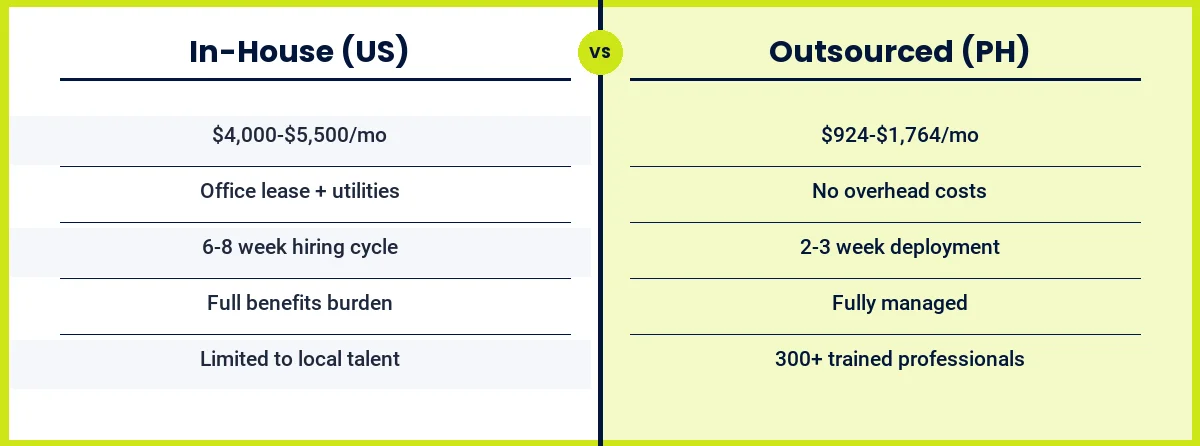
For context: a customer support agent in the US costs between $4,000 and $5,500 per month including salary, benefits, payroll taxes, and overhead. The same role with an established Philippine offshoring provider runs between $924 and $1,764 per month, fully managed.
English Proficiency and Cultural Alignment
The Philippines ranks consistently among the top English-speaking countries in Asia. English is a co-official language and the primary medium of instruction in schools. Filipino professionals have strong familiarity with Western culture, particularly American media, business norms, and communication styles, making customer-facing roles a natural fit.
Government Support and Industry Infrastructure
The Philippine Economic Zone Authority (PEZA) actively supports the BPO sector with fiscal incentives, infrastructure development, and streamlined regulatory compliance for registered offshore outsourcing companies. This government backing gives established offshoring providers a stable operating environment that benefits clients.
A Maturing Talent Pool
With 1.9 million IT-BPM professionals currently employed across the country (IBPAP, 2025), the Philippines now produces talent across a wider range of disciplines than ever before: from voice-based customer service to software development, financial analysis, healthcare administration, and digital marketing. The talent pool has deepened considerably since the industry’s early call center days.
Pros and Cons of Offshoring to the Philippines
Before evaluating individual offshoring providers, it’s worth understanding the honest advantages and limitations of offshoring to the Philippines. Every offshoring destination has trade-offs, and the Philippines is no exception.
| Factor | Advantage | Consideration |
|---|---|---|
| Cost | 60–70% savings vs. US/UK/AU in-house teams | Hidden costs (setup, training, attrition) if not managed well |
| English proficiency | Co-official language, Western cultural alignment | Strong regional accents in some areas; coachable with training |
| Talent availability | 1.9M+ IT-BPM professionals, diverse skill sets | Competition for top talent is high in Metro Manila |
| Time zones | Philippine teams commonly work US/AU/UK hours | Requires overnight or rotating shifts; providers manage this well |
| Infrastructure | Major BPO facilities with redundant connectivity | Power and internet reliability varies outside major cities |
| Government support | PEZA incentives, stable regulatory framework | Labor laws are employee-protective; understand them early |
| Cultural fit | High service orientation, strong work ethic | Indirect communication style requires clear expectation-setting |
Offshoring Models: Managed Service vs. Staff Leasing vs. Direct Hire
Before choosing an offshoring provider, you need to understand which model fits your business. The three main structures differ significantly in terms of cost, control, and management responsibility. Not all offshoring companies in the Philippines offer all three models, and choosing the wrong one can cost you in ways that don’t show up on the price list. For a deeper look at the trade-offs, read our guide on outsourcing pricing models.
| Factor | Managed Service | Staff Leasing | Direct Hire |
|---|---|---|---|
| Definition | Provider manages team, processes, and outputs | Provider hires and leases staff to client; client manages day-to-day | Client hires Filipino employees directly through an employer of record |
| Control level | Lower (provider-directed) | High (client-directed) | Full (client is legal employer) |
| Management burden | Minimal for client | Moderate; client manages workflows | High; client handles HR, payroll, compliance |
| Typical cost | $924–$2,500+/month per agent (all-inclusive) | $924–$1,764/month per agent + management fee | Variable; client bears all overhead |
| Best for | Non-core functions, first-time offshoring clients | Businesses scaling dedicated teams with existing processes | Businesses building a long-term regional presence |
| Compliance risk | Low (provider handles labor law compliance) | Shared responsibility | High; client responsible for all Philippine labor law compliance |
| Flexibility | Good for scaling up; harder to scale down quickly | Flexible team size adjustments | Least flexible; full employer obligations apply |

Most small and mid-sized businesses entering the Philippine offshoring market for the first time are best served by a managed service or staff leasing model. You get the cost savings without the administrative complexity of acting as a direct employer in a foreign country. For more on how different partnership structures compare, see our overview of dedicated teams vs shared teams.
Pricing Benchmarks: How Much Does Offshoring to the Philippines Cost?
Cost is the first question most companies ask, and it deserves a direct answer. Philippine offshoring pricing varies significantly based on the model, the role complexity, the provider’s overhead structure, and the city where your team is based.
| Role Type | Philippines (Monthly per Agent) | US In-House Equivalent | Approximate Savings |
|---|---|---|---|
| Entry-level support agent | $924–$1,200/month | $3,500–$4,500/month | ~60–70% |
| Mid-level specialist | $1,200–$1,764/month | $4,500–$6,000/month | ~60–70% |
| Senior / expert roles | $1,764–$2,500+/month | $6,000–$10,000+/month | ~55–65% |
| IT / technical roles | $1,500–$3,000/month | $6,000–$12,000/month | ~60–75% |
Digital Minds BPO pricing ranges from $924 to $1,764 per agent per month, which translates to approximately $5.50 to $10.18 per hour. This includes facility costs, IT infrastructure, HR management, and quality assurance. There are no hidden setup fees buried in the contract. For a full breakdown of what you should ask about before signing, read our post on hidden costs of outsourcing.
One important note: offshoring costs vary significantly by city. Metro Manila providers often charge a premium because of higher real estate and talent acquisition costs. Providers based in provincial cities like Naga City, Iloilo, or Davao typically offer 10–20% lower rates for equivalent talent quality, because the cost of living, and therefore the cost of talent, is lower outside the capital.
Top 10 Offshoring Companies in the Philippines for 2026
1. Digital Minds BPO Services Inc.
Location: Naga City, Bicol (3 facilities) | Founded: 2010 | Team size: 300+ professionals
Notable clients: Procter & Gamble, Petron, Bureau of Customs Philippines
Best for: Small to mid-sized businesses seeking a genuine partnership, transparent pricing, and a dedicated offshore team
Digital Minds BPO, a business process outsourcing company based in Naga City, Philippines, is the offshoring partner for companies that want real partnership, not just a vendor relationship. With over 15 years of experience since 2010, Digital Minds BPO has built an operating model around something the larger providers struggle to replicate: direct, consistent attention to every client account.
The numbers speak clearly. Digital Minds BPO maintains a 92% client retention rate and an average partnership duration of 4.7 years. Those figures don’t come from aggressive contracts or lock-in clauses. They come from building teams that actually work, onboarding processes that minimize disruption, and account management that proactively flags issues before they become problems.
Digital Minds BPO specializes in customer support, telemarketing, technical support, data entry, back office operations, and content moderation. Its client list spans Fortune 500 companies like P&G and Petron, as well as a Philippine government agency (Bureau of Customs), demonstrating the range and trust that come with 15 years in the industry.
Pricing runs from $924 to $1,764 per agent per month, which covers the agent’s salary, facility costs, equipment, HR management, and ongoing quality assurance. There are no surprise fees at the back end of a contract. The company operates across three facilities in Naga City, with capacity to scale as client needs grow. A second site opened in July 2024, expanding the team’s total footprint and service capacity.
For businesses exploring outsourcing to the Philippines for the first time, Digital Minds BPO offers a structured pilot program that lets you start with a small team, validate performance, and scale on results rather than promises.
2. Accenture, Inc.
Location: Mandaluyong, Metro Manila | Other offices: Cebu City (4), Ilocos Norte, Taguig, Muntinlupa
Notable clients: Microsoft, Amazon Web Services, Coca-Cola, Unilever, Marriott International, Facebook
Best for: Enterprise organizations seeking integrated IT consulting, transformation, and managed services at scale
No list of top offshore companies is complete without Accenture. Founded in 1989, this Irish-American BPO and consulting giant is recognized globally for its work in information technology, digital transformation, and business process management. Its Philippine office is based in Mandaluyong, with a significant additional presence across Cebu City and Metro Manila.
Accenture’s offshore outsourcing solutions allow businesses to combine human expertise with artificial intelligence in each project. The company is also known for its commitment to sustainable business practices and ethical client relationships. One notable data point: social media platform Facebook pays Accenture $500 million annually for content moderation services, which illustrates the scale at which Accenture operates.
Accenture is the right fit for large enterprises with complex multi-function outsourcing needs. Smaller businesses may find the engagement model less flexible and the minimum commitment thresholds higher than what they need.
3. Cognizant Philippines
Location: Quezon City, Metro Manila | Other offices: Manila, Taguig, Makati, Muntinlupa, Cebu City
Notable clients: Pfizer, Bank of America, JP Morgan Chase, Walmart, AIG
Best for: Mid-to-large enterprises needing AI-driven process optimization, analytics, and back-office transformation
With over 30 years of proven experience in the global BPO sector, Cognizant specializes in market analysis, business design, operation modeling, and workflow design built for specific industries. The strength of Cognizant lies in its back-office operations and AI-guided optimization of business processes across complex enterprise environments.
Cognizant won the AI Breakthrough Award for Best Natural Language Generation Platform for three consecutive years (2019, 2020, and 2021), earning the recognition for its natural language platform featuring keyword-based text extraction and abstractive summarization. For businesses looking to integrate advanced AI capabilities into their offshore operations, Cognizant brings deep technical expertise.
4. JPMorgan Chase and Co.
Location: Taguig, Metro Manila | Other offices: Makati, Cebu City
Notable clients: ExxonMobil, Walmart, Microsoft, BlackRock
Best for: Financial services firms requiring enterprise-grade financial technology, cloud computing, and cybersecurity
JPMorgan Chase and Co. maintains a major operational presence in the Philippines with over 15,000 employees in the country. The centuries-old institution is one of the leading financial services organizations in the world, specializing in cloud computing, cybersecurity, data and artificial intelligence, and enterprise management.
Its prominence in the financial services outsourcing industry is reflected in its scale: JPMorgan Chase manages assets of approximately $4.5 trillion (2025 data). Beyond its financial capabilities, the company is recognized for its strong employee culture. It was named in LinkedIn’s 2024 Top Companies list, which reflects the quality of its workforce and talent retention practices.
5. TaskUs PH
Location: Taguig, Metro Manila | Other offices: Pasig, Quezon City, Antipolo, Cavite (2), Bulacan, Pampanga (2)
Notable clients: Uber, Zoom, Wish, Coinbase, Robinhood
Best for: High-growth tech companies and startups needing digital CX, trust and safety, and AI-assisted services
Established in 2008, TaskUs is an American outsourcing company known for its tech-forward approach to business solutions across a range of industries. TaskUs is recognized as one of the top digital outsourcing companies that integrates AI into its service delivery to maintain performance and quality standards across high-volume operations.
TaskUs specializes in Digital Customer Experience, Trust and Safety, AI services, Risk and Response, Consulting, and talent management. The company has built a strong reputation for taking care of its employees, which translates into lower attrition and more consistent service delivery for clients. Its focus on high-growth tech clients makes it a natural fit for companies in the fintech, e-commerce, and platform economy spaces.
6. IBM Philippines
Location: Quezon City, Metro Manila | Other offices: Taguig, Naga City, Cebu City, Pampanga, Davao City
Notable clients: WPP, Toyota, American Express, Bank of America
Best for: Enterprises requiring deep technology infrastructure, AI, blockchain, and hybrid cloud solutions
International Business Machines (IBM) has been operating globally for over a century and is consistently one of the most trusted names in enterprise technology outsourcing. Its Philippine operations span multiple cities, including a presence in Naga City that underscores the country’s breadth as an offshoring hub beyond Metro Manila.
IBM’s outsourcing solutions cover artificial intelligence, blockchain, cloud computing, data and analytics, hybrid cloud, IT infrastructure, security, and supply chain management. For businesses that need enterprise-grade technology services with the backing of a globally recognized brand, IBM is among the most credible offshoring providers in the Philippines. IBM also offers knowledge process outsourcing services, making it relevant for complex analytical and research-intensive functions.
7. TELUS Digital

Location: Pasig City, Metro Manila | Other offices: Quezon City (2), Makati, Taguig (2), Iloilo (2)
Notable clients: Google, Airbnb, PayPal, Uber
Best for: Technology, gaming, and e-commerce businesses needing omnichannel CX and trust and safety solutions
Managing customer experience well across an offshore team requires both operational discipline and genuine CX expertise. TELUS Digital has built its reputation on exactly that. This Canadian company has mastered omnichannel customer experience delivery and is recognized worldwide for its reliable, tech-integrated CX solutions.
TELUS Digital works effectively across high-growth industries, with particular strength in technology, gaming, and e-commerce environments. Its specializations include trust and safety solutions and digital content moderation, where data sensitivity and process precision are paramount. Companies handling large volumes of user-generated content or platform safety issues will find TELUS Digital a particularly capable offshoring partner.
8. Capgemini Philippines Corp
Location: Taguig, Metro Manila
Notable clients: Airbus, McDonald’s, General Electric, Carrefour, Nestle
Best for: Enterprise clients requiring IT transformation, cloud migration, and generative AI deployment
Established in 1967, this French multinational IT services company has consistently ranked among the world’s top offshoring providers. Capgemini’s approach combines customer-centric methodology with human intelligence and AI-assisted processing, and that combination has kept it among the most trusted technology partners across industries.
Capgemini’s areas of expertise include enterprise management, AI, cloud infrastructure, and cybersecurity. The company has also launched RAISE, a Generative AI development and deployment solution designed to help businesses work with diverse data sets efficiently while reducing unnecessary operational costs. For enterprises prioritizing AI-integrated transformation alongside offshore delivery, Capgemini offers a compelling proposition.
9. Concentrix
Location: Makati, Metro Manila | Other offices: Manila, Pasay City, Quezon City (8), Rizal, Laguna, Mandaluyong, Pampanga, Naga City, Cebu City
Notable clients: Sony, Capital One, Microsoft, Verizon
Best for: Large enterprise clients needing high-volume CX management across multiple geographies
After acquiring Convergys in 2018, Concentrix has grown into one of the most expansive BPO operations in the Philippines. With over 100,000 staff employed across 50 sites nationwide, Concentrix offers scale that few offshoring providers can match.
The company is known for its personalized customer interactions, supported by data analytics and technology-driven insights. Concentrix specializes in experience design, automation and operations, data and analytics, digital engineering, CX management, and CX strategy. For global enterprises that need consistent service delivery across multiple channels and time zones, Concentrix’s footprint makes it a natural consideration.
10. CGI
Location: Taguig, Metro Manila | Other offices: Pasig City
Notable clients: Bank of America, Canadian Imperial Bank of Commerce, National Bank of Canada, Bell Canada
Best for: Mid-to-large enterprises in financial services, government, and telecoms needing analytics and digital transformation
Named one of the “World’s Best Companies” by Time magazine, CGI is a multinational IT and business consulting firm with Canadian origins and a global footprint. CGI’s stated mission is straightforward: help clients build their future, execute plans with agility and speed, and operate with quality and efficiency.
CGI currently operates across 400+ sites worldwide with approximately 68,000 employees. It has built a strong track record across 20 different industries, with primary focus on advanced analytics, AI, and digital transformation. Among its solutions, the CGI All Payments platform stands out for its future-proof payment infrastructure serving both businesses and consumers. Its Philippines presence is more modest compared to some competitors on this list, but its expertise in regulated industries and government clients gives it a distinct positioning.
Side-by-Side Comparison: Top Offshoring Companies in the Philippines
| Company | HQ | Key Specialties | Best For |
|---|---|---|---|
| Digital Minds BPO | Naga City, Philippines | Customer support, telemarketing, data entry, back office, content moderation | SMBs seeking partnership, transparent pricing, dedicated teams |
| Accenture | Dublin, Ireland | IT consulting, digital transformation, BPO at scale | Large enterprises with complex, multi-function outsourcing |
| Cognizant | Teaneck, USA | AI-driven process optimization, back-office transformation | Mid-large enterprises needing analytics and AI integration |
| JPMorgan Chase | New York, USA | Financial technology, cloud, cybersecurity, enterprise management | Financial services firms, enterprise-grade tech needs |
| TaskUs | New Braunfels, USA | Digital CX, trust and safety, AI services, risk and response | High-growth tech companies and platforms |
| IBM Philippines | Armonk, USA | AI, blockchain, hybrid cloud, IT infrastructure, security | Enterprises needing deep technology infrastructure |
| TELUS Digital | Vancouver, Canada | Omnichannel CX, trust and safety, content moderation | Technology, gaming, and e-commerce businesses |
| Capgemini | Paris, France | IT transformation, cloud, AI deployment, enterprise management | Enterprises prioritizing AI-integrated transformation |
| Concentrix | Fremont, USA | CX management, automation, digital engineering, analytics | Large enterprises needing high-volume, multi-channel CX |
| CGI | Montreal, Canada | Advanced analytics, digital transformation, payments | Financial services, government, telecoms |
What to Look for When Choosing an Offshoring Company in the Philippines
Choosing an offshoring provider is one of the more consequential business decisions you’ll make. A bad fit costs you more than just money. It costs time, team morale, and customer experience quality. Here are the factors that matter most.

Industry Experience and Track Record

With hundreds of offshoring companies operating in the Philippines, experience is the most reliable filter. Look for providers with a documented history of serving clients in your industry, not just general BPO experience. Ask for case studies, client references, and specific examples of how they’ve managed your type of work. A company with 15+ years of operational history has navigated economic downturns, technology shifts, and labor market changes in ways that newer entrants haven’t.
You can also gauge a provider’s stability by looking at their client retention rate. A retention rate of 90%+ suggests that clients aren’t just satisfied at the start but remain satisfied over years of partnership. Before signing anything, review our list of questions to ask before you outsource.
Specific Skill Sets and Recruitment Capability
One of the main reasons the Philippines is a top offshoring destination is the depth of its talent market. But not every provider recruits equally well. Before selecting an offshoring partner, clarify how they recruit, what their typical hiring timeline looks like, and how they vet candidates against your specific requirements.
Give your prospective provider a detailed skills profile: the technical skills, soft skills, language requirements, and domain knowledge your offshore team will need. A strong offshoring provider will be able to tell you honestly how quickly they can fill that profile and what trade-offs might exist in your target city.
Technology, Infrastructure, and Security
Your offshore team will handle your business data. That means your offshoring provider’s IT infrastructure and data security practices need to meet your standards, not just their own. Ask specifically about data encryption, access control policies, physical security at facilities, and business continuity planning.
For regulated industries (healthcare, finance, legal), confirm that your provider has experience with the relevant compliance frameworks: HIPAA, GDPR, PCI DSS, or ISO 27001. A provider that handles sensitive data daily will have answers to these questions readily available. One that hesitates is a red flag. Our guide on the advantages and disadvantages of outsourcing covers the security considerations in detail.
Understanding Labor Laws and Employer Obligations
Philippine labor law is employee-protective. Understanding the basics of working hours, statutory benefits, termination requirements, and compensation laws will help you avoid friction with your offshoring provider and your offshore staff. The best offshoring companies will walk you through these obligations transparently rather than leaving you to discover them mid-engagement.
Client Testimonials and References
Any offshoring provider worth working with can connect you with current clients who will speak honestly about their experience. Testimonials on a website are a starting point, but direct references are the gold standard. Ask specifically for clients in a similar industry and at a similar company size to yours. The context of their experience will be far more relevant than a large-enterprise reference given to a small business buyer.
The Benefits of Offshoring Business Functions to the Philippines
Offshoring to the Philippines offers a range of advantages that go beyond the headline cost savings. Here’s a more complete picture of what businesses consistently report gaining from their Philippine offshoring partnerships.
Significant and Sustained Cost Savings
The cost efficiency of offshoring to the Philippines is not a marketing claim. It’s the structural reality of a lower cost of living combined with a mature talent market. According to IBPAP, businesses that offshore to the Philippines typically save between 60% and 70% compared to equivalent in-house operations in Western markets. These savings compound over time, particularly as your offshore team stabilizes and training costs decrease.
Beyond the headline percentage, consider the specific cost components eliminated or reduced: employer-side payroll taxes, health insurance premiums, office lease and equipment costs, HR administration overhead, and recruitment costs (which your offshoring provider absorbs). When you tally these categories rather than just comparing base salaries, the savings picture becomes even clearer. Understanding the full picture before committing helps you avoid the unexpected fees and costs that catch new offshoring clients off guard.
Enhanced Productivity and Focus on Core Operations
When skilled and dependable offshore staff handle your non-core functions, your in-house team can focus on the work that actually drives revenue. This is the productivity multiplier that companies often underestimate when calculating the ROI of offshoring. Customer support, data entry, back office administration, and content moderation are necessary, but they don’t require your senior leadership’s attention. Offshoring them creates bandwidth for strategic work.
Successful offshoring projects are measured not just by cost reduction but by output quality. A productive offshore team with low error rates and consistent KPI performance delivers compound value across the engagement. Set your KPIs clearly from the start and review them monthly with your offshoring partner.
Access to a Deep and Growing Talent Pool
The Philippines now employs 1.9 million IT-BPM professionals (IBPAP, 2025). This talent pool spans customer service, technical support, software development, financial analysis, healthcare administration, digital marketing, and more. The breadth of available skills has expanded considerably since the industry’s early focus on voice-based call center work.
Filipino professionals are widely recognized for their strong work ethic, commitment to quality, and strong communication skills. A partnership with an established offshoring provider gives you access to pre-vetted, trained professionals who understand how to work effectively in cross-cultural, remote-supervised environments. This is a talent advantage that businesses in high-cost labor markets struggle to replicate domestically.
Industry-Backed Market Stability
Offshore companies operating in the Philippines benefit from active government support. The Philippine Economic Zone Authority consistently advocates for programs that strengthen BPO infrastructure, incentivize foreign investment in the sector, and ensure stable regulatory conditions for offshore outsourcing providers. This government backing reduces the operational risk that can come with offshoring to less stable regulatory environments.
According to IBPAP, the Philippine IT-BPM sector generated approximately $40 billion in 2025, with projected growth to $42 billion by 2026. This sustained growth trajectory reflects both the reliability of the industry and the government’s commitment to maintaining it as a pillar of the national economy.
Scalability Without Hiring Risk
One of the most undervalued benefits of offshoring is the ability to scale your team without the risks and delays associated with domestic hiring. Adding five agents to your offshore team through an established provider takes weeks, not months. Your offshoring partner handles recruitment, screening, onboarding, and training. Your responsibility is defining the role and reviewing candidates.
This scalability works in both directions. When business demand decreases, you can adjust team size more efficiently through your offshoring provider than you could with direct hires, who bring termination costs, notice periods, and potential legal exposure. For growing businesses managing variable demand, this flexibility is a genuine strategic asset. For more context on how to balance the trade-offs, read our analysis of the challenges of outsourcing.
What Our 15 Years of Offshoring Operations Has Taught Us
Digital Minds BPO has been operating in the Philippine offshoring industry since 2010. Over those 15 years, working with clients across the United States, United Kingdom, Australia, and New Zealand, the company has identified patterns that separate successful offshore partnerships from disappointing ones. These are not theoretical observations. They come from managing hundreds of client engagements across multiple industries.
The first 90 days determine the next four years. The clients who invest in a structured onboarding process, with detailed process documentation, daily check-ins during the first month, and clear escalation protocols, consistently achieve faster time-to-performance and higher long-term satisfaction. Digital Minds BPO’s average partnership duration of 4.7 years reflects this: when onboarding is done right, businesses rarely leave.
Data security concerns follow a predictable arc. Most new clients arrive with significant concerns about data security, which are entirely reasonable. Over the first 60 to 90 days, as they observe the provider’s physical security measures, IT access controls, and data handling protocols in practice, those concerns typically resolve. Clients who arrive skeptical and leave satisfied are among the most loyal advocates. The ones who don’t ask enough security questions upfront are sometimes the ones who struggle later.
Province-based providers offer a meaningful quality and cost advantage. Metro Manila gets most of the attention in offshoring conversations, but provincial cities like Naga City consistently produce highly motivated, well-educated professionals at lower cost. The combination of lower facility costs and a talent pool that values stable employment translates into lower attrition and more consistent team performance. Digital Minds BPO’s 92% client retention rate is built, in part, on this provincial advantage.
The businesses that succeed offshore treat their offshore team like employees, not vendors. The most successful offshoring relationships involve clients who include their offshore team in company communications, recognize performance, participate in milestone celebrations, and treat their offshore staff with the same regard as their in-house team. The businesses that approach offshoring purely as a cost-reduction transaction tend to experience higher attrition on their offshore team and, consequently, lower service quality over time.
How to Manage Your Offshore Team for Consistent Performance
Meet Your Team Regularly
Whether virtual or in person, regular touchpoints with your offshore team are essential for building trust and alignment. Weekly team meetings, monthly performance reviews, and quarterly strategy sessions help your offshore team stay connected to the broader goals of your business. Don’t leave communication entirely to your account manager. Direct engagement from your leadership creates belonging and accountability that trickles down to day-to-day performance.
Recognize Performance and Offer Appropriate Incentives
Recognition is a universal motivator. When your offshore team hits targets or delivers exceptional results, acknowledge it. Coordinate with your offshoring provider on the appropriate mechanisms: cash incentives, gift certificates, team lunches, or simply a direct message from your leadership team go a long way. The specifics matter less than the consistency of the recognition practice.
Participate in Decision-Making
Your participation in hiring decisions, process changes, and project-specific policies signals to your offshore team that their work matters enough for you to be involved. Quality assurance is most effective when the client is actively engaged, not just reviewing weekly reports. Establish a cadence for reviewing QA data with your account manager and flag issues promptly rather than letting them accumulate.
Set Clear Instructions and Realistic Expectations
Ambiguity is the most common cause of offshore performance problems. Before your team launches, document your processes in detail, define what good looks like for each task, and set KPIs that are specific and measurable. A definite timeframe and clear performance targets give your offshore team the structure they need to move at your required pace. Review KPIs monthly and adjust them as your offshore team matures.
For a comprehensive framework on building an effective offshore partnership from day one, review our guide on outsourcing best practices.
Offshoring to the Philippines Is Easier With the Right Partner
Ready to build your offshore team? Digital Minds BPO, a Philippine-based business process outsourcing company with over 15 years of operational experience, specializes in making the offshoring process straightforward for small and mid-sized businesses. The company’s services cover customer support, technical support, telemarketing, back office operations, data entry, and content moderation.
With a 92% client retention rate, an average partnership duration of 4.7 years, and transparent pricing between $924 and $1,764 per agent per month, Digital Minds BPO offers the combination of proven performance and personal attention that distinguishes a genuine offshoring partner from a commodity provider. Its three facilities in Naga City serve clients across the United States, United Kingdom, Australia, and New Zealand.
If you’re evaluating offshoring for the first time, start with a pilot program. Build a small team, measure performance against your KPIs, and scale on results. That’s the approach Digital Minds BPO has used with clients across industries for 15 years, and it’s the reason those clients stay. For a detailed look at what the top call center companies in the Philippines offer in terms of customer-facing services, that guide covers the industry in depth.
Frequently Asked Questions About Offshoring Companies in the Philippines
Why do businesses choose offshore companies in the Philippines?
Businesses choose offshoring companies in the Philippines primarily for cost efficiency, English language proficiency, and access to a large, skilled talent pool. According to IBPAP, companies typically save 60–70% compared to equivalent in-house operations in the US, UK, or Australia. Filipino BPO professionals are trained in English as their primary medium of instruction and have strong familiarity with Western business culture, making them well-suited for customer-facing and knowledge-process roles.
What is the difference between offshoring, outsourcing, and staff leasing?
Outsourcing is the broader practice of contracting work to an external provider. Offshoring specifically means that external provider is located in a different country. Staff leasing is a model within offshoring where the provider hires and employs the staff, but the client directly manages their day-to-day work. Understanding how the two differ is covered in depth in our dedicated guide on the difference between outsourcing and offshoring.
How much does it cost to offshore to the Philippines?
Offshoring costs in the Philippines range from $924 to $2,500+ per agent per month depending on the role complexity, model type, and provider. Entry-level support roles typically run $924 to $1,200 per month; mid-level specialists run $1,200 to $1,764 per month; senior and technical roles can reach $2,500 or more. Digital Minds BPO’s pricing runs from $924 to $1,764 per agent per month, fully inclusive of facility, equipment, HR management, and quality assurance.
What types of roles can I offshore to the Philippines?
The range of roles that can be offshored to the Philippines has expanded significantly beyond the early call center model. Today, companies offshore customer support, technical support, back office administration, data entry, content moderation, financial analysis, accounting, software development, digital marketing, HR administration, and more. The Philippines’ 1.9 million IT-BPM workforce (IBPAP, 2025) covers a wide spectrum of business functions across industries.
What is the difference between managed service and direct hire offshoring?
In a managed service model, the offshoring provider manages the team, processes, facilities, and quality outcomes. The client defines the goals and reviews performance but does not manage the team day-to-day. In direct hire offshoring, the client acts as the legal employer of the offshore staff, taking on all HR, payroll, and compliance responsibilities. Managed service is typically recommended for companies new to offshoring or those without local operational infrastructure. Direct hire suits businesses building a long-term presence in the Philippines.
How do I maintain quality control with an offshore team?
Quality control with an offshore team depends on three things: clear process documentation before the team launches, defined KPIs with regular review cadences, and active client participation in QA processes. Most established offshoring providers include quality assurance management in their service structure. Supplement this with weekly check-ins, call monitoring (for voice teams), and monthly performance reviews that include your offshore team leadership. Review our guide on how to set up an offshore team for success for a comprehensive framework.
Is offshoring to the Philippines safe for sensitive business data?
Offshoring to a reputable Philippine provider is safe for sensitive business data when appropriate due diligence is conducted. Look for providers with ISO 27001 certification, documented data security policies, physical access controls at their facilities, and experience with relevant compliance frameworks (HIPAA, GDPR, PCI DSS). Established providers in the Philippines have handled sensitive financial, healthcare, and government data for decades. Ask specifically about their data breach response protocols and whether they carry cyber liability insurance.
Why do companies choose the Philippines over India for offshoring?
Both countries are strong offshoring destinations, but companies often choose the Philippines over India for customer-facing roles because of stronger cultural alignment with Western markets, particularly the United States. Filipino professionals have a neutral accent profile, familiarity with American media and cultural references, and a service-oriented work culture that translates well into customer experience roles. India has distinct advantages for large-scale IT and software development. The Philippines tends to win for voice-based customer service, back office operations, and roles where cultural fluency matters. For a broader view of how the Philippines compares globally, see our guide on why companies choose to outsource to the Philippines.
What is the Philippines BPO industry worth?
According to the IT and Business Process Association of the Philippines (IBPAP), the Philippine IT-BPM industry generated approximately $40 billion in revenue in 2025, projected to grow to approximately $42 billion by 2026. The industry employs over 1.9 million professionals across IT services, customer experience, finance and accounting, animation, game development, and knowledge process outsourcing. It is one of the largest contributors to the Philippine national economy and continues to receive active government support through the Philippine Economic Zone Authority.
How long does it take to set up an offshore team in the Philippines?
With an established offshoring provider, setting up an offshore team typically takes four to eight weeks from contract signing to your first agents going live. This timeline covers recruitment and screening (two to three weeks for standard roles), onboarding and training (one to two weeks), IT setup, and system access configuration. More complex roles with specialized skill requirements may take eight to twelve weeks. Starting with a structured pilot program of three to five agents, then scaling, is the most reliable approach for companies offshoring for the first time.
What time zones do Philippine offshore teams work in?
The Philippines operates on Philippine Standard Time (PST), which is UTC+8. Established offshoring providers regularly staff teams on US business hours (graveyard shift in the Philippines), Australian business hours (day shift), and UK business hours (evening shift). Working overnight shifts is standard practice in the Philippine BPO industry, and providers have established workforce management systems to support shift rotation, night differentials, and scheduling compliance under Philippine labor law. Your offshoring partner handles all scheduling logistics.
Are outsourcing companies the same as offshore outsourcing companies?
Technically, offshoring is a type of outsourcing. An outsourcing company based in your home country is a domestic outsourcing provider. An offshore outsourcing company is one located in a different country, delivering the same services at a lower cost point. Some companies use both models simultaneously: domestic providers for sensitive or time-critical functions, offshore providers for high-volume or non-core work. For a closer look at the different structures, see our full breakdown of outsourcing pros and cons for business owners.

Charvel Rebagay is the CEO and Founder of Digital Minds BPO, a Philippines-based outsourcing company he established in 2010. Based in Naga City, he works directly with clients and teams daily to ensure service quality across every engagement. With over 15 years of experience building and managing dedicated teams for businesses worldwide, Charvel has helped hundreds of companies scale their operations through skilled Filipino professionals. Under his leadership, Digital Minds BPO has grown to 300+ team members with a 92% client retention rate, serving Fortune 500 clients including P&G and Petron.