Medical billing outsourcing means handing charge entry, coding, claim submission, payer follow-up, and patient statements to a team outside the practice, rather than staffing that work in-house. Search for this topic and two answers dominate: a US billing company that quotes a percentage of what it collects on the practice’s behalf, or a vague promise of savings with no number attached. Neither answer is complete.
This guide covers how outsourced medical billing actually works, the two ways it gets priced, what it costs in 2026 with real figures instead of “contact us for a quote,” and when a dedicated billing hire makes more sense than a percentage-based vendor. Digital Minds BPO has built dedicated teams for US clients since 2010, and its healthcare BPO services include medical billing and coding roles. The rate published later in this guide is its current published rate for that role.
What Is Medical Billing Outsourcing?
Medical billing outsourcing is the practice of contracting an outside team, onshore or offshore, to handle some or all of a practice’s revenue cycle: coding, claim submission, denial management, accounts receivable follow-up, and patient statements. The work happens inside the practice’s own EHR and clearinghouse, using its existing payer contracts and fee schedules. The outsourced team operates one of two ways: as a percentage-based vendor managing the whole cycle for a share of collections, or as a dedicated hire, an in-house-equivalent biller or coder, billed at a flat hourly or monthly rate.
Billing is one function inside a larger shift, already covered in Digital Minds BPO’s guide to healthcare process outsourcing. This guide stays narrow: how the billing function specifically works, and what it costs under each pricing model.
How Medical Billing Outsourcing Actually Works
The work breaks into five stages. Most vendors run all five as one continuous cycle, not five separate services billed apart.
Charge Entry and Coding
Before a coder ever touches a claim, someone has confirmed the patient’s coverage. Practices that check insurance eligibility at scheduling catch coverage gaps before the visit happens, not after the claim bounces. Once the visit is documented, a coder translates the provider’s notes into CPT, ICD-10, and HCPCS codes, and charge entry posts those codes with the associated fees into the practice management system.
A miscoded claim at this stage often surfaces three weeks later as a denial. That lag is why complex specialties, cardiology and orthopedics especially, typically request a certified coder for this step rather than a generalist.
Claim Submission
Once coded and entered, a claim goes to the clearinghouse, then to the payer, usually as an electronic 837 file. A clean claim clears the payer’s front-end edits and moves into adjudication. A dirty claim, one with a mismatched NPI, a wrong modifier, or a missing prior authorization, gets kicked back before a human at the payer ever sees it.
This work is largely mechanical, and it is where a dedicated hire earns their keep. The same person submitting the same practice’s claims every day learns that specific payer’s quirks faster than a rotating queue at a percentage-based vendor typically does.
Payer Follow-Up
Not every claim adjudicates on the first pass. Payer follow-up means calling or checking a portal on claims sitting past the payer’s usual turnaround, typically 14 to 30 days depending on payer and claim type. It is unglamorous, repetitive work, and it is also the stage most likely to get deprioritized inside a busy in-house billing department that is also fielding patient calls and posting payments.
Denials and AR
A denied claim needs a reason code read correctly, a decision on whether to correct and resubmit or appeal, and a deadline tracked against the payer’s appeal window, which can run as short as 90 days for some commercial payers. Accounts receivable follow-up applies that same discipline to the entire aging bucket: claims sitting at 30, 60, and 90-plus days need someone actively working them, not a report that lists them. Teams that specialize in this stage typically organize AR by aging bucket and payer, working the oldest and highest-dollar claims first.
Patient Statements
After insurance pays its portion, the remaining balance goes to the patient, and this is also where most patient billing calls start: why is there a balance, can a payment plan be set up, did insurance already cover this. Practices that route patient billing enquiry calls to a team trained on the practice’s own statement format and payment options keep those questions off front-desk staff who were never trained to answer them.
This is also where a dedicated medical billing team pays off in a way a percentage vendor’s shared call queue rarely matches: the person answering the phone already worked the claim and can explain the balance directly, without a transfer.
The Two Ways Medical Billing Outsourcing Is Priced
Almost every vendor in this space prices one of two ways, and few explain the difference plainly, because the difference determines who carries the risk when a practice’s volume drops.
Percentage of Collections
GetPracticeHelp’s 2026 pricing guide puts the going rate at 4 to 10 percent of collections, most commonly 5 to 8 percent for a small or mid-size practice, a range Neolytix independently repeats. Both are vendor marketing pages, not audited research, and that distinction matters more than it looks. No independent, audited study of the 4 to 10 percent range exists anywhere in the public record. No primary body such as MGMA or HFMA publishes a clean, publicly reachable percentage-by-practice-size table either. Every number attached to this range, including the two above, traces back to a billing vendor describing its own market. Treat the range as directional: it is sourced from the sellers, not from an audit.

At 5 to 8 percent, a practice collecting $2 million a year pays $100,000 to $160,000 annually for billing, and that cost rises automatically as revenue rises, whether or not the billing workload rose with it. Scope also varies enormously under an identical headline percentage: some quotes cover claim submission only, with denial follow-up, AR, and credentialing billed separately later. Compare two percentage quotes without confirming scope, and the lower number is usually the thinner service, not the better deal.

Dedicated FTE
Percentage vendors sell you a share of your own collections. Digital Minds BPO sells you a person.
The alternative model is simple to describe and hard to find published anywhere in the US billing industry: a dedicated person, billed at a flat hourly or monthly rate, working only the claims and patients that belong to one practice. Digital Minds BPO’s outsource medical billing services work this way. The practice gets a recruited, trained biller or certified coder who reports to its own workflow and job description, and the invoice does not move when collections move.
This is the honest version of the difference. A percentage vendor sells an outcome, a portion of the revenue its process helped collect. A dedicated-FTE provider sells a person, recruited, trained, and managed to do the work the practice defines. Digital Minds BPO staffs the second model. It does not operate a revenue cycle on a practice’s behalf, and it does not promise a collection rate, a clean-claim rate, or a denial rate, because none of those outcomes belong to a staffing company. They belong to the process the practice and its hired biller run together.
Which One Fits Your Volume
Percentage-of-collections fits a practice with unpredictable or seasonal volume and no bandwidth to manage a direct hire. The vendor absorbs the slow months, and the practice never has to think about training or coverage. It also fits a solo practitioner billing too few claims a month to justify a dedicated person’s time.
A dedicated FTE fits a practice with steady, predictable volume, an EHR and clearinghouse already in place, and a preference for a named person who knows the account rather than a pooled queue. A flat rate does not rise with collections, which makes the comparison arithmetic rather than opinion.
At Digital Minds BPO’s published rates, a full year of a dedicated biller costs $15,120 at the Entry tier and $25,200 at the Expert tier. That comes in under a single percentage point of collections for a practice collecting more than about $1.5 million a year, or more than about $2.5 million if the role needs a certified coder. Below those thresholds a flat rate can still be cheaper in absolute dollars than a percentage quote, but the sub-one-percent framing stops holding, and the threshold is the part most vendor comparisons leave out.
What Medical Billing Outsourcing Costs in 2026
Three pricing structures show up in 2026 quotes, and the rates many comparison articles are still citing are several years stale.
Percentage-of-collections quotes still cluster at 4 to 10 percent, typically 5 to 8 percent, per the sourcing above. Per-claim, full-service pricing (billing the whole claim rather than only submission) runs $4 to $12 per claim, a range that four or more independent compilations converge on, though no single authority publishes it.
What almost no US billing company publishes is a flat monthly rate per person. CareCloud states on its own pricing page that it does not disclose its revenue cycle management rates, and athenahealth, AdvancedMD and Tebra publish software pricing rather than a billing-service rate. Philippine and LatAm providers publish flat per-FTE monthly rates instead, running from roughly $1,400 to $2,600 a month depending on role and region. Those figures come from individual vendors’ own published rate cards, not from a surveyed market, so read the range as a sample rather than an average. Digital Minds BPO’s rate card sits in that published market, not the US percentage market.
| Tier | Monthly | Hourly |
|---|---|---|
| Entry | $1,260 | $7.50 |
| Mid | $1,596 | $9.50 |
| Expert (certified CPC/AAPC coder) | $2,100 | $12.50 |
Every rate is billed against actual attendance hours at 168 hours a month, not a flat fee charged whether or not the hours were worked. The Expert tier is for a role that needs a current AAPC Certified Professional Coder (CPC) or AHIMA Certified Coding Specialist (CCS) credential, typically for a multi-specialty practice or one running its own denial appeals.
In-House vs Outsourced Medical Billing
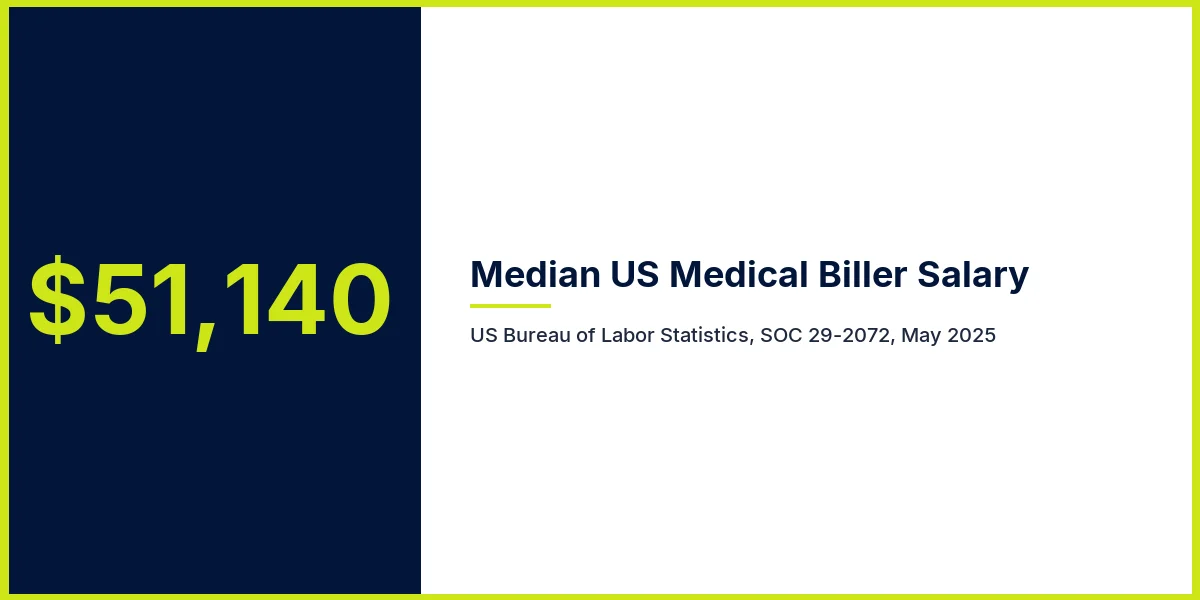
The Bureau of Labor Statistics puts the median wage for the closest matching occupation, medical records specialists (SOC 29-2072, a category that explicitly includes medical coders), at $51,140 a year, $24.59 an hour, as of May 2025. Applying BLS’s own private-industry benefits load of roughly 1.3x to that wage puts a fully loaded in-house hire at approximately $66,480 a year, about $5,540 a month. That figure is Digital Minds BPO’s own calculation from a BLS wage input, not a published third-party number.
| Factor | In-House | Outsourced (Dedicated FTE) |
|---|---|---|
| Fully loaded monthly cost | ~$5,540/mo (BLS wage x benefits load) | $1,260 to $2,100/mo, billed hourly |
| Hiring and cover | Practice recruits, interviews, and arranges coverage for leave and turnover | Recruiting, leave coverage, and replacement if the fit is wrong are built into the arrangement |
| Denial handling | Whoever is available handles it, often while also answering phones | A dedicated person whose job is the billing queue, not a shared task |
| Software and systems | Practice already owns or must purchase | Works inside the practice’s existing EHR and clearinghouse; no new software required |
| Turnover risk | Turnover is the practice’s risk to absorb; institutional knowledge leaves with the hire | The outsourcing provider manages backup and replacement, reducing single-point-of-failure risk |
| Control | Direct, day-to-day management | Practice sets the job description and workflow; day-to-day HR sits with the provider |
Neither column wins outright once every variable is counted. A practice with a skilled, low-turnover in-house biller already doing good work has little reason to switch. The comparison matters most for a practice about to hire for the first time, replace someone who left, or open a second location.
When Outsourcing Medical Billing Pays Off, and When It Does Not
Outsourcing pays off fastest for a practice that already has a functioning EHR and clearinghouse, billing rules and payer contracts that are documented even if only informally, and enough steady volume to keep a dedicated person busy. It also pays off for a practice opening a second location or adding a provider, where hiring a second in-house biller competes for the same local labor pool as every other practice in town.

It does not pay off, at least not the dedicated-FTE version, in a few specific situations. A solo practitioner billing genuinely low volume each month may find a percentage-based vendor cheaper in absolute dollars, since a flat rate only makes sense once there is enough work to fill the hours.
A practice with no documented process and no time to spend the first 30 to 60 days training a new hire will struggle under either model, but struggles faster with a dedicated hire, because a percentage vendor’s existing infrastructure absorbs some of that ramp-up. And a practice that wants zero involvement, no job description to write and no workflow to define, is a better fit for a full-service percentage vendor that owns the whole process end to end.
The decision comes down to whether the practice wants to buy a process or hire a person, and whether its volume and documentation are ready for either one.
How to Choose a Medical Billing Partner
The criteria below apply whether a practice is evaluating a percentage vendor, a dedicated-FTE provider, or both side by side.
| Criteria | What to Look For |
|---|---|
| HIPAA compliance and BAA | A signed Business Associate Agreement before any patient data changes hands, and documented HIPAA Privacy and Security training for staff touching claims |
| Pricing clarity | A published rate or a clearly scoped percentage, not “contact us for a quote” with no ceiling |
| Coding credentials | AAPC or AHIMA-certified coders available for specialty or complex claims, not only data-entry staff |
| Scope in writing | Exactly which stages (coding, submission, follow-up, denials, AR, statements) are included, and which are billed separately |
| EHR and clearinghouse compatibility | Direct experience inside the practice’s specific system, not a generic claim of working with “all systems” |
| Denial and AR process | A described method for working aging claims, with named steps rather than a general promise to follow up |
| Data security | Access controls, audit logging, and a clear answer on where PHI is stored and processed |
| Are you buying an outcome or a person? | A percentage model sells an outcome tied to collections; a dedicated-FTE model sells a person tied to a job description. Confirm which one is actually being priced. |
What to Ask Before You Sign
- What exactly is included in the percentage or flat rate, and what gets billed separately?
- Is a Business Associate Agreement provided before onboarding starts, or after?
- Who specifically will work our account, and is that person dedicated or shared across clients?
- What coding certifications does the person or team hold?
- How is an existing denials backlog handled during transition, and how long does transition take?
- What is the AR follow-up cadence, and how are aging buckets prioritized?
- What happens if the assigned person leaves or is out sick? Is there backup coverage?
- Can we see a sample of monthly reporting before signing?
- What is the contract term, and what does it take to exit if the fit is wrong?
- Is pricing fixed for the contract term, or can it change based on our collections?
Conclusion
Medical billing outsourcing comes down to one choice most comparison articles skip entirely: buy an outcome from a percentage vendor, or hire a person at a published rate. Both are legitimate. The percentage model fits unpredictable volume and little appetite for management. The dedicated-FTE model fits steady volume, an existing EHR, and a preference for a named biller who knows the account.
Digital Minds BPO has built dedicated back-office and healthcare teams since 2010. Across every vertical it serves, client retention runs 94% and the average partnership lasts 4.7 years. For a practice better served by a dedicated biller or certified coder at a published hourly rate than by a percentage of its own revenue, Digital Minds BPO’s medical billing outsourcing services are built for exactly that model.
Frequently Asked Questions About Medical Billing Outsourcing
Is outsourcing medical billing a good idea?
It depends on volume and documentation more than on whether outsourcing beats in-house billing in general. A practice with steady volume, an EHR already in place, and a preference for predictable cost tends to do well with a dedicated outsourced hire. A practice with low, unpredictable volume or no appetite for managing a direct hire is often better served by a percentage-based vendor that absorbs the swings.
How much does it cost to outsource medical billing?
Percentage-based vendors typically charge 4 to 10 percent of collections, most commonly 5 to 8 percent for a small or mid-size practice. Full-service, per-claim pricing runs $4 to $12 per claim. Dedicated-FTE pricing, the model Digital Minds BPO uses, runs $1,260 to $2,100 a month depending on tier, billed hourly against actual attendance.
What are the best medical billing outsourcing companies in the USA?
The strongest fit depends on which pricing model a practice wants. Percentage-based, full-service RCM vendors dominate the US market, while dedicated-FTE providers publishing flat rates are more common among Philippine and LatAm BPO firms. Digital Minds BPO’s roundup of healthcare BPO companies compares options across both models.
Is AI replacing medical billers?
Not currently, and not the way headlines suggest. AI tools now assist with claim scrubbing and denial-reason categorization, catching errors before submission, but a person still has to read a denial, decide whether to appeal or correct it, and call a payer when automated tools disagree with each other. The billing role is shifting toward AI-assisted work, not away from the person doing it.
How do outsourced and in-house medical billing solutions compare?
Cost is the clearest difference. A fully loaded in-house hire runs close to $5,540 a month by Digital Minds BPO’s own calculation from BLS wage data, against $1,260 to $2,100 a month for a dedicated outsourced hire at comparable tiers. In-house keeps the person on-site under direct daily supervision. Outsourced trades some of that direct oversight for lower fixed cost and built-in backup coverage.
How do medical billing outsourcing solutions compare on customer support?
A percentage-based vendor typically routes patient billing calls into a shared support queue that also handles other clients’ patients. A dedicated-FTE hire, because that person already worked the claim, can usually explain a specific balance directly rather than escalating it. Neither is universally better for support. It depends on whether patients need a specialist queue or a single accountable point of contact.
Do you sign a BAA?
Yes. A Business Associate Agreement is available on request before any patient data is shared, along with documentation of HIPAA Privacy and Security training completed by staff handling healthcare accounts.
What happens to our denials backlog during transition?
The dedicated hire’s first weeks typically go toward working the existing aging AR and denials queue alongside onboarding, rather than only starting fresh claims. A clean handoff needs read access to current claims and denial history from day one. How fast that backlog moves depends mostly on how quickly the practice grants that access and how well its existing denial history is documented, not on the hire alone.

Sofia Reyes is a Content Writer and SEO Specialist at Digital Minds BPO, where she focuses on outsourcing-industry research and educational content for business decision-makers. Based in the Philippines, she has 7 years of experience writing B2B content across SEO, content strategy, and Generative Engine Optimization (GEO). Sofia partners with Digital Minds BPO’s operations and account management teams to translate 15+ years of frontline BPO experience into clear, sourced guides on call center, customer service, and back-office outsourcing. Her work supports prospects evaluating outsourcing decisions across the company’s three dedicated facilities, where the team delivers a 94% client retention rate for clients ranging from Fortune 500 enterprises to growth-stage businesses.